Pain Management Billing in Illinois: Common Coding Mistake
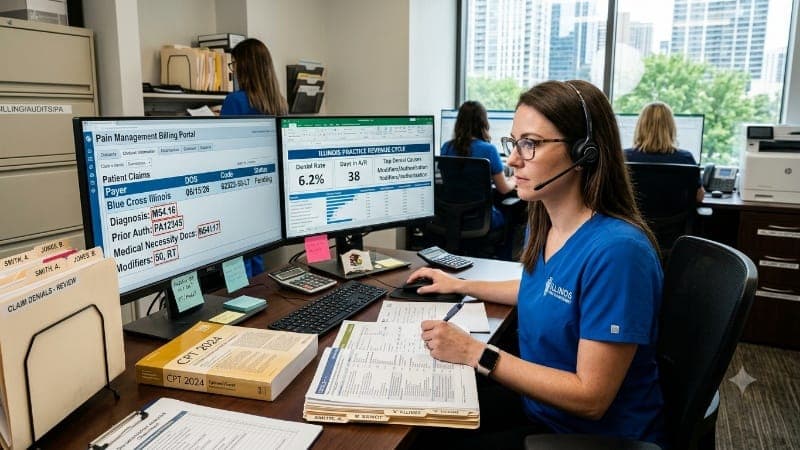
Unlike many specialties that rely on routine office visits and standard procedures, pain management practices perform a wide range of injections, nerve blocks, radiofrequency procedures, spinal cord stimulator services, and other interventions that require highly specific coding and extensive documentation. Even small coding mistakes can result in claim denials, delayed reimbursements, compliance concerns, and lost revenue.

For pain management practices across Illinois, accurate billing is essential for maintaining healthy cash flow and ensuring patients continue receiving timely care. Insurance companies closely review pain management claims because many procedures involve high reimbursement amounts, strict medical necessity requirements, and prior authorization rules.
Claim denials create challenges that extend beyond lost revenue. They increase administrative workload, slow reimbursement cycles, raise accounts receivable balances, and divert staff resources toward appeals and resubmissions. In some cases, repeated coding errors can trigger payer audits and compliance investigations.
Industry studies consistently show that healthcare providers lose significant revenue each year due to preventable billing and coding errors. For pain management practices, where procedural services make up a substantial portion of revenue, even a modest increase in denial rates can have a substantial financial impact.
This guide explains the most common coding mistakes that cause claim denials, discusses Illinois-specific billing considerations, and outlines practical strategies that can help practices improve reimbursement and reduce revenue cycle disruptions.
Understanding Pain Management Billing in Illinois
What Makes Pain Management Billing Unique?
Pain management billing differs from many other medical specialties because providers often perform multiple procedures during a single encounter while navigating complex payer requirements.
Multiple Procedure Types
Pain management specialists commonly perform:
Epidural steroid injections
Facet joint injections
Trigger point injections
Radiofrequency ablation
Spinal cord stimulator procedures
Nerve blocks
Joint injections
Each procedure has unique coding requirements, documentation standards, and reimbursement guidelines.
High Documentation Requirements
Most pain management procedures require detailed documentation demonstrating medical necessity. Insurers often expect comprehensive clinical notes that support both diagnosis and treatment decisions.
Frequent Insurance Scrutiny
Pain management claims are frequently reviewed by commercial insurers, Medicare, and Medicaid due to the complexity and cost associated with many procedures.
Prior Authorization Requirements
Many interventional pain procedures require prior authorization before treatment is provided.
Medical Necessity Reviews
Payers routinely evaluate whether procedures meet established medical necessity criteria before approving reimbursement.
The Real Cost of Coding Errors for Illinois Pain Management Practices
How Coding Errors Affect Revenue
Increased Claim Denials
Incorrect coding is one of the leading causes of claim denials. When claims are denied, practices must invest additional time and resources to correct and resubmit them.
Delayed Reimbursements
Even when claims are eventually approved, coding issues can significantly delay payment.
Higher Administrative Costs
Staff members often spend hours researching denials, correcting claims, obtaining documentation, and communicating with payers.
Increased Accounts Receivable
Unresolved denials can lead to growing accounts receivable balances and cash flow challenges.
Audit Risks
Repeated coding errors may increase the likelihood of payer audits and documentation reviews.
Compliance Risks
Improper coding practices can expose practices to compliance concerns and potential penalties.
Most Common Coding Mistakes That Cause Claim Denials
1. Incorrect CPT Code Selection
Why It Happens
Pain management procedures often involve multiple coding options that vary based on technique, anatomical location, imaging guidance, and clinical circumstances.
Examples of Common CPT Coding Errors
Selecting outdated procedure codes
Using incorrect procedure descriptions
Coding procedures that do not match documentation
Applying bundled services incorrectly
Impact on Reimbursement
Incorrect CPT codes frequently result in immediate denials, reduced reimbursement, or requests for additional documentation.
How to Prevent It
Review annual coding updates
Conduct regular coding audits
Verify procedure documentation before claim submission
Train coding staff on specialty-specific guidelines
2. Missing or Incorrect Modifiers
Modifiers play a critical role in pain management billing.
Common Modifiers Used in Pain Management
Modifier 25
Modifier 50
Modifier 59
Modifier XU
Modifier RT
Modifier LT
Common Modifier Mistakes
Missing required modifiers
Using modifiers without supporting documentation
Applying incorrect laterality modifiers
Using Modifier 59 when another modifier is more appropriate
Real-World Denial Scenarios
Many insurers deny claims when procedures performed on separate anatomical sites are not properly distinguished through modifier usage.
Best Practices
Ensure all modifiers are supported by provider documentation and payer-specific billing guidelines.
3. Insufficient Documentation Supporting Medical Necessity
One of the most common causes of pain management claim denials is inadequate documentation.
What Insurers Expect
Payers require evidence that the procedure is medically necessary.
Required Clinical Documentation
Patient History
Complete pain history, symptom duration, and treatment progression.
Diagnosis
Clear documentation supporting the diagnosis being treated.
Failed Conservative Treatments
Evidence of unsuccessful conservative therapies such as physical therapy, medications, or home exercise programs.
Imaging Studies
Relevant imaging results when required.
Treatment Plans
Detailed treatment goals and expected outcomes.
Documentation Red Flags
Missing clinical findings
Generic treatment plans
Incomplete progress notes
Lack of medical necessity justification
Denial Prevention Tips
Implement documentation checklists and provider education programs to ensure records support billed services.
4. Incorrect ICD-10 Diagnosis Coding
Importance of Diagnosis Accuracy
Diagnosis codes establish medical necessity and justify procedural services.
Common Diagnosis Coding Errors
Selecting unspecified diagnoses when more specific codes are available
Using outdated diagnosis codes
Coding unsupported diagnoses
Diagnosis and Procedure Mismatch Issues
Claims are frequently denied when diagnosis codes do not support the procedure performed.
Medical Necessity Concerns
Payers often review whether the diagnosis justifies the treatment rendered.
Documentation Alignment
Documentation must consistently support both diagnosis and procedure coding.
5. Billing Non-Covered Services
Understanding Payer Policies
Coverage policies vary significantly between insurance carriers.
Coverage Limitations
Many insurers impose limitations regarding eligible procedures and clinical criteria.
Frequency Restrictions
Certain injections and pain procedures have frequency limitations.
Authorization Requirements
Failure to obtain authorization may result in denial even when the procedure is medically necessary.
Avoiding Non-Covered Claim Denials
Review payer policies before scheduling procedures and verify coverage requirements in advance.
6. Failure to Verify Prior Authorization Requirements
Why Prior Authorizations Matter
Many pain management procedures require payer approval before treatment.
Common Authorization Mistakes
Missing authorizations
Incorrect procedure information
Scheduling procedures before approval
Expired Authorizations
Expired approvals frequently result in denials.
Procedure Changes After Approval
Any procedural changes may require updated authorization.
Best Practices for Authorization Management
Implement tracking systems to monitor authorization status and expiration dates.
7. Unbundling Services Incorrectly
What Is Unbundling?
Unbundling occurs when services that should be billed together are reported separately.
Examples in Pain Management Billing
Certain procedural components may already be included in comprehensive procedure codes.
Compliance Risks
Improper unbundling may trigger payer scrutiny and compliance concerns.
Payer Audits
Repeated unbundling errors often attract audit attention.
Correct Coding Practices
Follow National Correct Coding Initiative (NCCI) edits and payer-specific billing guidelines.
8. Duplicate Claim Submissions
How Duplicate Claims Occur
Duplicate submissions often result from communication breakdowns or billing system issues.
Impact on Revenue Cycle
Duplicate claims can delay processing and reimbursement.
Payer Responses
Many payers automatically reject duplicate submissions.
Prevention Strategies
Use claim tracking systems and establish clear submission workflows.
9. Incorrect Place of Service (POS) Codes
Common POS Codes for Pain Management
Pain management services may be performed in:
Office settings
Ambulatory surgery centers
Hospitals
Outpatient facilities
Frequent POS Errors
Incorrect location reporting can lead to reimbursement discrepancies.
Reimbursement Consequences
Payers often apply different reimbursement methodologies based on POS selection.
Correct POS Selection
Verify the service location before claim submission.
10. Billing Services Outside Payer Guidelines
Frequency Limitations
Many pain procedures have strict utilization limits.
Medical Necessity Thresholds
Additional procedures may require stronger clinical justification.
Procedure-Specific Requirements
Each payer may establish unique billing criteria.
How to Stay Updated
Monitor payer policy updates regularly and educate staff accordingly.
Procedure-Specific Coding Mistakes in Pain Management
Epidural Steroid Injection Billing Errors
Common Denials
Missing medical necessity documentation
Incorrect CPT code selection
Authorization issues
Coding Challenges
Accurate reporting depends on the specific spinal region treated.
Documentation Requirements
Clinical findings, imaging results, and treatment rationale should be clearly documented.
Facet Joint Injection Coding Mistakes
Coding Guidelines
Facet procedures require precise coding based on anatomical location and levels treated.
Modifier Requirements
Laterality modifiers may be necessary depending on the procedure.
Common Rejections
Claims may be denied when documentation fails to support the reported levels.
Radiofrequency Ablation Billing Errors
Procedure Documentation
Detailed procedural notes are essential.
Frequency Restrictions
Many payers limit the number of allowable treatments.
Medical Necessity Requirements
Documentation should demonstrate previous successful diagnostic procedures when required.
Trigger Point Injection Billing Mistakes
Common Coding Issues
Incorrect muscle group reporting
Documentation deficiencies
Diagnosis mismatch
Documentation Errors
Missing treatment rationale often contributes to denials.
Denial Prevention
Ensure procedural details and clinical indications are clearly documented.
Spinal Cord Stimulator Billing Challenges
Trial vs Permanent Implant Coding
Separate coding requirements exist for trial and permanent implantation procedures.
Device Billing Issues
Device-related billing often requires additional documentation.
Authorization Requirements
Prior authorization is commonly mandatory.
Illinois-Specific Challenges in Pain Management Billing
Illinois Medicaid Billing Considerations
Illinois Medicaid maintains specific billing requirements for pain management services.
Coverage Policies
Coverage eligibility varies based on procedure type and clinical necessity.
Authorization Rules
Many services require prior approval before treatment.
Documentation Standards
Providers must maintain complete and accurate documentation supporting treatment decisions.
Commercial Insurance Requirements in Illinois
Pain management providers frequently work with insurers such as:
Blue Cross Blue Shield
Aetna
Cigna
UnitedHealthcare
Humana
Each payer may maintain unique requirements regarding authorization, documentation, and medical necessity.
Common Payer-Specific Denials
Missing prior authorization
Insufficient documentation
Frequency limitation violations
Diagnosis mismatches
Warning Signs Your Pain Management Practice Has a Coding Problem
High Denial Rates
An increase in denials often signals coding or documentation issues.
Increasing Accounts Receivable
Growing receivables may indicate unresolved claim problems.
Repeated Requests for Documentation
Frequent documentation requests suggest potential medical necessity concerns.
Rising Write-Offs
Excessive write-offs can negatively impact profitability.
Slow Payments
Extended payment timelines often indicate billing inefficiencies.
Frequent Appeals
A growing appeal workload may reflect recurring coding errors.
How to Reduce Claim Denials in Pain Management Billing
Conduct Regular Coding Audits
Internal Audits
Routine internal reviews help identify coding trends and errors.
External Audits
Independent evaluations provide objective feedback and compliance insights.
Invest in Staff Training
Coding Updates
Keep billing teams informed about annual coding changes.
Documentation Standards
Train providers on documentation best practices.
Compliance Education
Maintain ongoing compliance awareness across the organization.
Strengthen Documentation Processes
Provider Education
Providers should understand documentation requirements for each procedure.
Templates
Standardized templates can improve consistency.
Quality Checks
Pre-submission reviews help identify deficiencies before claims are filed.
Monitor Key Revenue Cycle Metrics
First-Pass Claim Rate
Measures claims paid without correction.
Denial Rate
Tracks overall claim denial performance.
Collection Rate
Evaluates reimbursement effectiveness.
Days in Accounts Receivable
Monitors payment cycle efficiency.
Use Specialty-Specific Billing Experts
Pain management billing requires specialized expertise.
Benefits of Specialized Pain Management Billing
Reduced denials
Improved coding accuracy
Faster reimbursements
Stronger compliance performance
Better revenue cycle outcomes
Practices seeking dependable Pain Management Billing Services in Illinois often benefit from partnering with professionals who understand payer requirements, modifier usage, medical necessity standards, and pain management coding complexities.
Why Many Illinois Pain Practices Outsource Billing
Challenges of In-House Billing
Managing pain management billing internally can be difficult due to:
Constant coding updates
Staffing challenges
Denial management demands
Compliance requirements
Benefits of Outsourcing
Certified Coders
Experienced coders help improve claim accuracy.
Denial Management
Dedicated teams actively manage denied claims.
Revenue Optimization
Specialized billing professionals identify reimbursement opportunities.
Compliance Monitoring
Ongoing compliance oversight reduces risk.
Scalability
Outsourced solutions can grow alongside the practice.
For many providers, professional Pain Management Billing in Illinois offers a practical way to reduce administrative burdens while maximizing reimbursement and maintaining compliance.
Conclusion
Pain management billing presents unique challenges that require careful attention to coding accuracy, documentation quality, payer requirements, and compliance standards. Common mistakes such as incorrect CPT coding, missing modifiers, diagnosis mismatches, authorization failures, and insufficient medical necessity documentation continue to be major causes of claim denials.
For Illinois pain management practices, proactive denial prevention is critical to maintaining healthy cash flow and maximizing revenue. Regular coding audits, ongoing staff education, robust documentation processes, and close monitoring of revenue cycle performance can significantly reduce preventable denials.
Accurate coding not only improves reimbursement but also strengthens compliance and reduces audit risk. Whether managed internally or through specialized Pain Management Billing in Illinois, investing in billing excellence can help practices achieve faster payments, stronger financial performance, and a more efficient revenue cycle.
By reviewing billing processes regularly and addressing coding vulnerabilities before claims are submitted, pain management providers can improve collections, reduce administrative burdens, and focus more time on delivering exceptional patient care.
Frequently Asked Questions
What are the most common pain management claim denials?
The most common denials involve incorrect CPT codes, missing modifiers, insufficient documentation, authorization issues, diagnosis mismatches, and frequency limitation violations.
Which modifiers are frequently used in pain management billing?
Common modifiers include Modifier 25, Modifier 50, Modifier 59, Modifier XU, Modifier RT, and Modifier LT.
How can Illinois pain clinics reduce denial rates?
Clinics can reduce denials through coding audits, staff training, documentation improvements, authorization verification, and ongoing compliance monitoring.
What documentation is required for pain management claims?
Documentation typically includes patient history, diagnosis, failed conservative treatments, clinical findings, imaging studies when applicable, treatment plans, and procedural notes.
Why are epidural injection claims denied?
Common reasons include missing medical necessity documentation, authorization issues, coding errors, and insufficient clinical support.
How often should pain management coding audits be performed?
Most practices benefit from quarterly audits, although higher-volume practices may require more frequent reviews.
Is outsourcing pain management billing worth it?
Many practices experience reduced denial rates, improved collections, and stronger compliance when working with experienced pain management billing specialists.
How can practices improve reimbursement rates?
Improving documentation quality, ensuring coding accuracy, obtaining authorizations, monitoring payer policies, and utilizing specialized billing expertise can significantly improve reimbursement performance.
Calvin Hart
Contributor at Jorvea — Free Guest Blogging & Content Publishing Platform
Frequently Asked Questions
What are the most common pain management claim denials?
The most common denials involve incorrect CPT codes, missing modifiers, insufficient documentation, authorization issues, diagnosis mismatches, and frequency limitation violations.
Which modifiers are frequently used in pain management billing?
Common modifiers include Modifier 25, Modifier 50, Modifier 59, Modifier XU, Modifier RT, and Modifier LT.
How can Illinois pain clinics reduce denial rates?
Clinics can reduce denials through coding audits, staff training, documentation improvements, authorization verification, and ongoing compliance monitoring.
What documentation is required for pain management claims?
Documentation typically includes patient history, diagnosis, failed conservative treatments, clinical findings, imaging studies when applicable, treatment plans, and procedural notes.
Why are epidural injection claims denied?
Common reasons include missing medical necessity documentation, authorization issues, coding errors, and insufficient clinical support.