

How Recruiters Decide Which Engineers Get Interviews
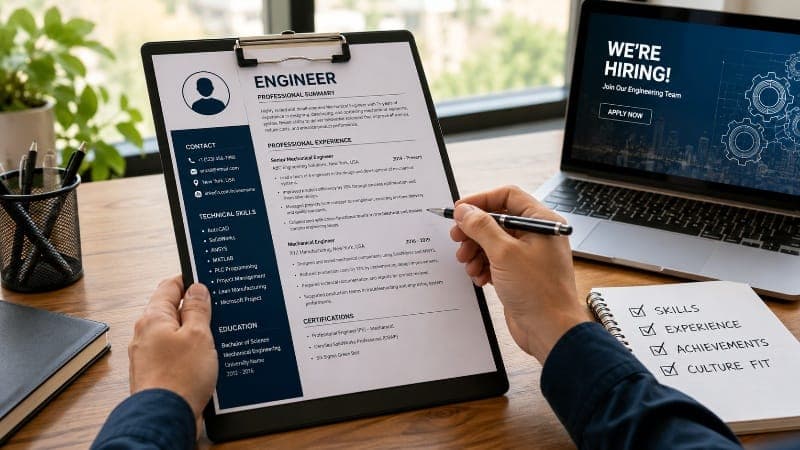
Engineering is one of the most competitive professions today. Every job posting attracts candidates with strong educational backgrounds, technical certifications, and years of hands-on experience. On paper, many applicants appear equally qualified. Yet only a small percentage receive interview invitations.
Why does that happen?
The answer isn't always about having more experience or mastering another software program. In many cases, the deciding factor is how effectively an engineer presents their qualifications on a resume.
Recruiters don't meet you before reviewing your application. They don't know your work ethic, your problem-solving ability, or your technical expertise beyond what appears on those pages. Your resume becomes your first opportunity to demonstrate why you're the right person for the role.
Today's hiring process moves quickly. Recruiters often review dozens or even hundreds of applications for a single engineering position. That means your resume has only a brief moment to capture attention and communicate value.
A well-written resume tells a clear story. Instead of simply listing jobs and responsibilities, it shows employers the problems you've solved, the projects you've completed, and the measurable impact you've made throughout your career. This is one reason many professionals invest in an Engineering Resume Writing Service in USA to ensure their experience is presented strategically while remaining authentic.
Recruiters Scan Before They Read
One of the biggest misconceptions among job seekers is believing recruiters carefully read every resume from beginning to end.
In reality, the first review is usually much faster.
Recruiters scan resumes looking for important details that immediately indicate whether a candidate matches the position.
They typically look for:
Relevant engineering experience
Industry-specific expertise
Technical competencies
Career progression
Certifications and licenses
Leadership experience
Project achievements
If these details are easy to identify, recruiters are more likely to continue reading.
If they struggle to understand your background within the first few seconds, they often move on to the next application.
This isn't because your experience lacks value.
It's because your resume failed to communicate that value efficiently.
A clean, organized engineering resume allows recruiters to quickly connect your qualifications with the employer's requirements.
Employers Hire Engineers Who Solve Problems
Engineering has always been about solving problems.
Whether you're designing mechanical systems, improving manufacturing processes, developing software, or managing infrastructure projects, employers ultimately want engineers who can produce meaningful results.
Unfortunately, many resumes fail to communicate this.
Instead of describing achievements, candidates often list routine responsibilities.
For example:
Responsible for project planning.
Assisted senior engineers.
Performed quality inspections.
Prepared engineering documentation.
While these statements explain your duties, they don't explain your value.
Recruiters are much more interested in outcomes.
Did your design reduce production costs?
Did your process improvements increase efficiency?
Did your project finish ahead of schedule?
Did your recommendations improve product quality?
These accomplishments demonstrate your contribution to the organization.
Whenever possible, include measurable results.
Simple metrics such as percentages, cost savings, production improvements, reduced downtime, or project completion times immediately strengthen your credibility.
Numbers help recruiters visualize the impact you've made throughout your career.
A Strong Resume Reflects Business Value
Technical knowledge is essential in engineering, but companies don't hire engineers simply because they know software or understand technical concepts.
Businesses hire engineers because they solve business challenges.
That's an important distinction.
Your technical resume should connect your engineering knowledge with practical outcomes.
Instead of simply listing AutoCAD, SolidWorks, MATLAB, PLC programming, Python, Revit, or other software, explain how you applied those tools to improve performance, support production, reduce errors, or complete successful projects.
Context matters.
Recruiters aren't impressed by long lists of software.
They're impressed by engineers who know how to use those tools to deliver measurable business results.
The strongest resumes balance technical expertise with practical accomplishments.
That balance immediately separates outstanding candidates from average applicants.
Professional Presentation Builds Immediate Trust
Presentation may seem less important than technical experience, but recruiters notice it immediately.
An organized resume tells employers something valuable before they read a single sentence.
It suggests attention to detail.
It reflects professionalism.
It demonstrates clear communication.
These qualities matter in every engineering discipline.
Avoid overcrowded pages filled with long paragraphs and unnecessary technical jargon.
Instead, use consistent headings, concise bullet points, logical formatting, and enough white space to improve readability.
A resume should guide recruiters naturally from one section to another without making them search for important information.
Simple presentation almost always outperforms overly designed templates because clarity is what employers value most.
A professional layout also improves readability for applicant tracking systems, making it easier for your application to move through the initial screening process.
Why Career Progression Matters More Than You Think
Recruiters don't only evaluate your current job title. They also look for evidence that you've continued growing throughout your engineering career.
This is one of the most overlooked aspects of resume writing.
Two candidates may both have eight years of experience, but recruiters often prefer the one whose resume shows increasing responsibility, leadership, and professional development.
Think about your career journey.
Did you begin by supporting senior engineers before eventually leading projects?
Have you managed larger budgets, coordinated with clients, supervised teams, or taken ownership of critical engineering systems?
These details tell a powerful story.
They show that employers trusted you with greater responsibility over time.
A resume that demonstrates career progression immediately suggests reliability, adaptability, and long-term potential. Hiring managers aren't just filling today's vacancy—they're also considering who could become a future team lead, project manager, or senior engineering specialist.
Even if your job titles haven't changed dramatically, you can still highlight growth by emphasizing expanded responsibilities, more complex projects, and broader business involvement.
Recruiters Look for Relevance, Not Just Experience
Many engineers make the mistake of sending the same resume to every company.
It seems efficient, but it often reduces interview opportunities.
A manufacturing employer may prioritize process optimization and equipment reliability. A consulting firm may focus on client communication and project delivery. A software-focused engineering company may value automation, data analysis, and cross-functional collaboration.
Recruiters want to see that your experience aligns with their specific role.
Before applying, carefully review the job description and identify the skills, technologies, and responsibilities emphasized by the employer.
Then adjust your resume accordingly.
This doesn't mean rewriting your entire document for every application. Small changes can make a significant difference:
Move the most relevant projects higher on the page.
Emphasize technical skills that match the role.
Use terminology that naturally reflects the employer's priorities.
Highlight achievements related to the specific engineering discipline.
This targeted approach helps recruiters immediately recognize your suitability for the position.
Soft Skills Influence Technical Hiring Decisions
Engineers sometimes underestimate the importance of communication and collaboration.
However, modern engineering projects rarely happen in isolation.
Recruiters frequently look for evidence that you can work effectively with:
Cross-functional teams
Production departments
Quality assurance teams
Clients and stakeholders
Suppliers and vendors
Senior management
Junior engineers
Technical expertise may earn attention, but strong professional skills often determine who advances to the interview stage.
Consider experiences where you:
Presented technical recommendations to leadership.
Led project meetings.
Coordinated with multiple departments.
Mentored junior team members.
Resolved conflicts during project execution.
Communicated complex ideas to non-technical audiences.
These examples demonstrate leadership, communication, and problem-solving abilities that employers highly value.
The Role of ATS in Engineering Hiring
Most large companies use Applicant Tracking Systems (ATS) to screen resumes before a human recruiter reviews them.
This doesn't mean you should stuff your resume with keywords.
In fact, keyword stuffing often makes resumes sound robotic and can reduce readability.
Instead, focus on creating an ATS-friendly resume by naturally incorporating relevant engineering terms, certifications, software, methodologies, and industry-specific language.
For example, if a job description mentions:
Lean manufacturing
Six Sigma
PLC troubleshooting
CAD design
FEA analysis
Project management
Root cause analysis
Include these concepts where they genuinely reflect your experience.
The goal is alignment, not manipulation.
A resume that reads naturally while matching the employer's terminology performs better for both ATS systems and human recruiters.
Keep Your Resume Updated Before You Need It
One habit that separates proactive professionals from reactive job seekers is regular resume maintenance.
Many engineers wait until they're unhappy in their current role before updating their resume. By that time, important project details may be forgotten.
A better strategy is to update your resume whenever you:
Complete a major project
Earn a certification
Receive a promotion
Improve a process
Achieve measurable results
Take on new responsibilities
Lead a successful initiative
This ensures your accomplishments remain accurate and detailed.
It also makes future job applications much less stressful because your resume already reflects your current level of experience.
Recruiters Notice the Small Details
By the time a recruiter reaches the end of your resume, they've already formed an opinion about your professionalism.
That opinion isn't based on a single achievement. Instead, it's built from dozens of small details working together.
Is the resume easy to follow?
Are the dates consistent?
Do the achievements sound credible?
Is the formatting clean?
Are technical skills supported with real project examples?
Every section contributes to your overall impression.
Even highly qualified engineers can lose opportunities if their resumes appear rushed, disorganized, or filled with unnecessary information.
A polished resume reflects something employers value in every engineer—attention to detail.
Show How Your Work Made a Difference
Recruiters aren't only interested in what you completed. They also want to understand why your work mattered.
Think beyond the technical tasks themselves.
Ask yourself questions like:
Did your solution reduce production downtime?
Did you improve product quality?
Did your recommendations lower operating costs?
Did you help a project stay on schedule?
Did your design improve safety or efficiency?
Did your process save time for the engineering team?
These outcomes demonstrate business value.
Employers invest in engineers because they expect measurable improvements.
When your resume explains both the challenge and the result, it becomes much more persuasive.
This approach also helps your experience feel authentic rather than exaggerated.
Build a Resume That Reflects Your Professional Brand
Your resume should present a consistent picture of who you are as an engineer.
Every section should support the same message.
If you're a mechanical engineer specializing in manufacturing, your projects, technical skills, certifications, and achievements should reinforce that expertise.
If your background focuses on civil engineering, automation, electrical systems, or product design, your resume should naturally highlight those strengths.
Avoid including information simply to fill space.
Every sentence should answer one important question:
How does this help demonstrate my value to the employer?
When your resume has a clear focus, recruiters understand your professional identity much faster.
That's one reason many candidates work with an Engineering Resume Writing Service in the USA—to ensure their experience is presented with clarity, consistency, and relevance rather than simply listed in chronological order.
Continuous Learning Makes a Strong Impression
Engineering is constantly evolving.
New technologies, software, regulations, and methodologies continue changing how engineers work.
Recruiters appreciate candidates who continue developing their knowledge throughout their careers.
Professional certifications, technical training, workshops, leadership programs, and continuing education all demonstrate commitment to professional growth.
Even learning a new engineering software platform or completing an industry certification can strengthen your resume.
Employers want engineers who are prepared not only for today's challenges but also for tomorrow's opportunities.
Showing continuous learning sends that message clearly.
Quality Always Beats Quantity
Many engineers assume that a longer resume automatically creates a stronger application.
In reality, recruiters value relevance far more than length.
A focused resume filled with meaningful accomplishments is much more effective than pages of repetitive responsibilities.
Remove outdated experience that no longer supports your career goals.
Avoid unnecessary technical jargon.
Eliminate repetitive bullet points.
Instead, focus on the projects, achievements, and skills that best demonstrate your qualifications.
Final Thoughts
Recruiters don't choose engineers based solely on experience—they choose candidates who communicate their value clearly. A strong resume highlights measurable achievements, relevant technical expertise, career progression, and the ability to solve real business problems. When your accomplishments are presented in a clear and professional way, employers can quickly recognize your potential. By tailoring your resume, focusing on results, and keeping your information current, you'll improve your chances of standing out in a competitive job market. If you're struggling to position your experience effectively, an Engineering Resume Writing Service in the USA can help transform your background into a resume that aligns with modern hiring expectations while staying true to your professional story.
📖 Read more blogs: Jorvea — Free Guest Blogging & Content Publishing Platform
Frequently Asked Questions
Is it worth using an Engineering Resume Writing Service in USA?
If you're not getting interview calls despite having strong experience, a professional service can help present your qualifications more effectively and align your resume with current recruiter expectations.
How important are measurable achievements on an engineering resume?
They're extremely important because they demonstrate the real impact of your work through results such as cost savings, efficiency improvements, quality enhancements, or successful project delivery.
Should engineers customize their resume for every application?
Yes. Tailoring your resume to match the job description makes your experience more relevant and increases your chances of getting shortlisted.
What do recruiters look for first in an engineering resume?
Recruiters usually look for relevant experience, technical expertise, measurable achievements, career progression, and a clean, easy-to-read format.