How Automation Systems Are Changing Software Development
Just a few years ago, it was hard to believe that there would ever be a time when software could write itself – it felt more like something you would read in a textbook, or a fictional story, than an actual development tool that could help developers at any level. But now, these types of agents, which can take any goal, break it down into smaller steps, make decisions while completing the steps, and then execute those tasks with only minimal assistance from a developer, have gone from being a novelty implementing into their daily workflows.
The impact of AI agents on software development reflects the rapid evolution of the Artificial Intelligence Market in two significant ways. First, they have changed how developers build, review, test, and maintain code. Second, they have reshaped the role of developers in the software creation process when all or part of the development is handled by non-human systems. As the Artificial Intelligence Market continues to expand, understanding these changes is essential because they will influence how development teams are structured, how technical skills are valued, and how software delivery quality is managed in the years ahead.
In this article, we will examine what AI agents are, in terms of how they are currently being utilized in software development, where they succeed, where they fail, and what current indications suggest about the future of AI agents in software development.
What Makes an AI Agent Different from a Coding Assistant
Understanding the difference makes an impact on the way in which a particular technology will be able (or unable) to perform.
A coding assistant, i.e., something which autocompletes a function or, while typing, proposes a block of code in response to your typing, is a reactive technology. It reacts to what you are currently typing. It does not plan things. A coding assistant does not initiate anything, nor does it do anything automatically.
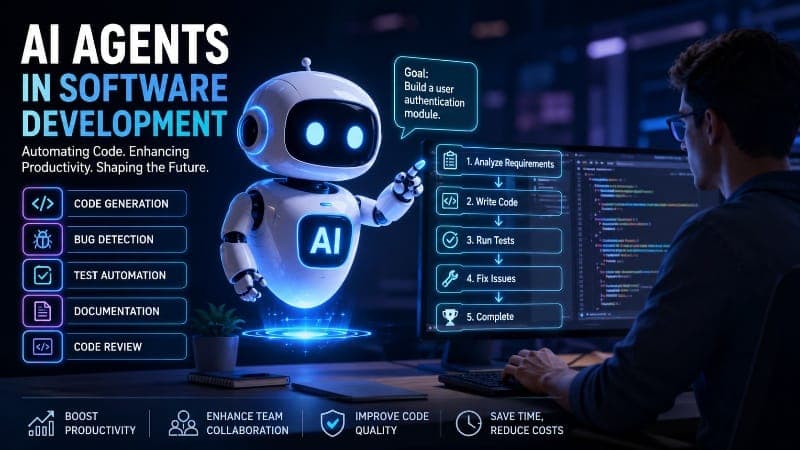
An AI agent is entirely different from a coding assistant. An AI agent will receive a goal and/or a task description and will determine what steps are necessary to accomplish that goal/task, will execute the steps in order, will evaluate the results of executing the steps and will modify its execution plan if an error occurs at any point in the sequence. An AI agent will also interact with other tools (i.e., executing code, querying databases, looking for definitions, making a call to an API, outcome that meets the established goal/task until an acceptable outcome has been created or until the AI agent determines it has become stuck and requires additional input from a user.
Since the AI agent has the capacity to accomplish tasks that require multiple steps, include an increasing number of dependencies as well as have an increasing number of decision points, the capabilities of the AI agent represent a significantly increased range of possible applications than was available using the earlier automated tools which were limited to the single-step completions of the original automated tools. The increased range of possible application does, however, increase the potential for failure.
Where AI Agents Are Actually Being Used in Development Today
Successful applications exhibit common characteristics: completion can be clearly known to the agent, the agent has structured data to reliably use, and the ramifications of mistakes can be caught by human review prior to inflicting irreparable harm.
Code generation through specifications is now possible (agents are capable of generating complete code across files, rather than just one function, that implements specifications consistently). While there is still a need for human review of the output of generated code and something commonly referred to as "edge cases" may still need to gap between an initial implementation and specification.
Automated testing and bug detection provides an agent with the ability to generate test cases, identify areas with little existing test coverage and locate potential bugs by analysing code for patterns that exist within the error types that are commonly created. Some teams are using agencies as part of their CI/CD processes to catch errors prior to giving input on a code's validity to human reviewers.
Code Review Help. Agents will help with the more mechanical parts of code review. They will not replace the need for human code review, but will help with fixing style inconsistencies, highlighting obvious errors, and making sure that code changes do not create obvious security issues so that human reviewers will be able to concentrate more on larger design and logic decisions.
Documentation Generation. One of the least attended responsibilities of software development is keeping documentation in sync with the codebase. By generating and updating documentation automatically from code, agents will generally create documentation that is correct and current more often than can be done manually.
Refactoring and Migration Work. Moving an entire codebase to another framework, changing all deprecated API calls, or re-organizing code to be consistent with a new architected solution are all projects where agents can perform a large number of identical transformations quickly while encoding a consistent transformation across an entire codebase.
Debugging Help. By providing agents with an error message, a stack trace, and a piece of code that they have access to, agents will be able to analyze potential causes of that error, recommend solutions, and in some cases apply a solution and test it. This will avoid the back and forth between developer and environment that a developer would normally have to go through.
The Technologies Underneath the Capability
By gaining insight into how AI agents perform today, we can begin to better understand both their limitations and capabilities.
At the heart of the reasoning capabilities of these AI agents are large language models (LLMs). LLMs are responsible for all about. The real utility and functionality of an AI agent is directly related to the ability of the underlying model to maintain a consistent line of reasoning throughout multiple-step, complex tasks.
Tool пайдалану is responsible for turning a language model into a functional AI agent that can actually perform work in a software development environment. Today’s AI agents allow for the ability to make function calls, run code in a sandboxed environment, read and write files, search and retrieve data from the internet, and interact with other external services. The ability to use tools changes the range of tasks that an AI agent will be able to work on effectively.
Memory and Context Management are responsible for how an agent maintains coherence throughout a lengthy task. When working with a large codebase, an agent needs to hold a large amount of context, including the repository's structural layout (in this case, it is being defined), the conventions being applied, and previous constraints established; agents perform this by utilizing both what can fit into the agent's active context window and the retrieval mechanisms that will allow the agents to retrieve knowledge applicable to the active context.
Planning & Orchestration is the layer that decomposes a high-level goal into multiple more concrete steps, defines how to react when an agent encounters an obstacle in any given step (for example, the item a developer expects to be returned is not returned), and manages the order in which the agent will execute all of the steps associated with achieving the overall goal. It is at this stage that agent quality exhibit the greatest amount of deviation based upon the type of agent implementation utilized.
What Development Teams Are Learning from Early Adoption
Teams who have been using AI agents productively and long enough to provide honest evaluations share some recurring themes.
Agents are better at covering a wide range of things than delving deeply into any one thing. When carrying out tasks that require the repeated application of an established pattern over a broad area, agents do well. However, when performing tasks that require a lot of reasoning regarding a new problem (e.g. determining why an architectural choice was made, debugging something that requires intuition about how a system will react), humans will do substantially better than agents.
The quality of the prompt itself greatly impacts the quality of the result produced by the agent. Vague or ambiguous goals are not conducive to having agents work properly. Teams that received great results have put forth the effort to write detailed task definitions containing necessary context, clearly stated constraints and explicit success criteria. This task also requires skill.
Reviewing work products still plays an important role when using agents, as agents too can produce error-ridden work. Code is sometimes correct for the conditions preset in testing (the agent can be right at that time) but may fail after going into production because the agent only wrote the code without having considered the production server’s conditions. Teams that view agent output as in need of a review (not deemed finished) generally have better results than those teams that have viewed agent output as a rubber stamp.
There are real-time savings to be had, with
various levels of uniformity. There are certain types of work items
(boilerplate generation, test creation, documentation, migration-related work
items) that enable users to gain significant, consistent efficiencies. Users
will incur greater-than typical overhead for agents when dealing with other
work items (i.e., complex and/or new features, debugging minor nuances that
involve concurrent execution, and performance optimizing).
The Challenges That Honest Practitioners Acknowledge
When using AI tools to create applications, be aware that AI tools have capabilities as well as limitations. Many people want to use these tools but are not aware of all of their limitations, which can lead to misuse. The following are some limitations of AI tools for creating applications:
AI tools may produce output that appears to be correct or "confident." However, that output might actually not be correct because a defect is hidden within the code being generated. An example would be generating code that passes all tests but has a defect in some edge cases. In other words, the code may work in test cases pass or fail based on hidden defects.
AI Tools can cause cascading errors (such as one error impacting many subsequent steps) due to how the AI tool sequences all of its work. If an early defect is not realized until many steps later in a complex application, it may be very difficult to find all of the files or pieces of code that have been affected by that defect. Traditional development tools have been known to exhibit single-point errors, where an error was only found in one piece of code and not throughout the entire application.
AI tools have performance challenges when used with larger codebases. As most AI-based code generators are not able to keep contextually cohesive reasoning across multiple files in a large codebase (and there is ongoing research to try to develop new techniques to deal with this limitation), it would not be advisable to create an enterprise-level or transactional application with current AI-based code generation tools.
The development of skills for junior developers is an area of concern. There is a need to learn how to develop software by working through problems, creating mistakes and learning why things have gone wrong. If agents assist in the boring but educational steps of the software development process, there will be questions regarding how can junior developers develop the competences they will require to be successful. To date, there isn't a consensus on this subject but it is beginning to be addressed by the industry.
📖 Read more blogs: Jorvea — Free Guest Blogging & Content Publishing Platform
Digital Akshay (Akshay Kumar)
Contributor at Jorvea — Free Guest Blogging & Content Publishing Platform
Frequently Asked Questions
What separates an AI agent from a simpler AI coding tool like GitHub Copilot?
A tool like Copilot works within your editor and responds to what you're currently writing — it's offering suggestions in context. An AI agent operates more independently: given a goal, it plans the steps needed to achieve it, executes them using available tools (running code, reading files, making calls), evaluates the results, and continues until the task is complete or it needs input. The distinction is between a responsive assistant and an autonomous executor.
Are AI agents writing production code at real companies right now?
Yes, though the degree of autonomy varies considerably. Some organizations use agents to generate initial implementations that developers then review and refine. Others use them for specific bounded tasks — writing tests, generating documentation, handling migration work — within otherwise human-led development processes. Fully autonomous agents deploying code to production without human review exist but are much less common, and the risk profiles make most organizations cautious about that level of autonomy.
What kinds of development tasks are agents least suited for today?
Tasks that require deep contextual understanding of a complex existing system, creative problem-solving for novel challenges, judgment about architectural trade-offs with long-term implications, or debugging of subtle emergent behaviors in distributed systems. These categories tend to require the kind of intuition and domain-specific reasoning that current agents handle less reliably than routine, well-specified implementation work.
How should development teams think about reviewing agent-generated code?
The same way they should think about reviewing any code — with the added awareness that agent-generated code may have systematic blind spots. Agents tend to be good at writing code that passes the tests they generate, but weaker at anticipating conditions they weren't asked to consider. Reviewers should pay particular attention to edge cases, error handling, security implications, and whether the implementation actually solves the right problem, not just the problem as literally specified.
What does AI agent adoption mean for developers who are early in their careers?
This is one of the more genuinely uncertain questions. If agents handle the implementation work that junior developers traditionally learned from, the path to developing deep technical competence may need to evolve. Some argue that working alongside agents will accelerate learning; others worry it will reduce the kind of struggle that builds understanding. Practically, developers who invest in understanding systems deeply - not just writing code but understanding why it works and what can go wrong - seem better positioned than those who rely on agents to handle the thinking.

_1779088582913.jpg&w=1200&q=75)