The Future of AI in Pakistan: Tech Revolution & Top Startups
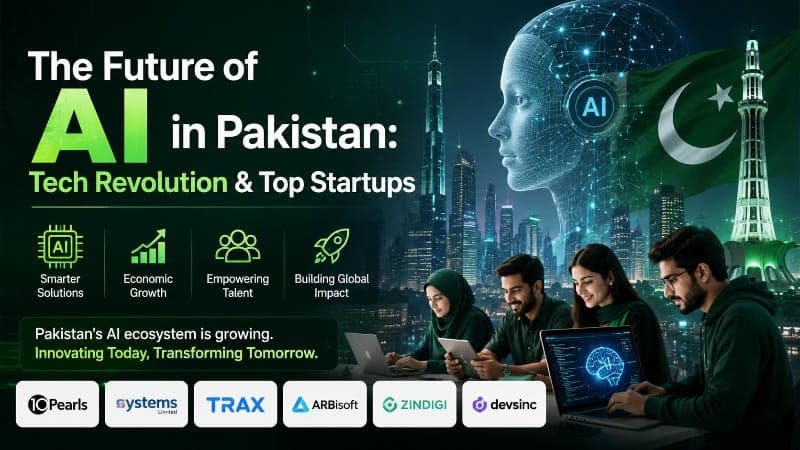
Artificial intelligence is no longer a futuristic concept whispered in the corridors of Silicon Valley; it has officially arrived on Pakistani soil, igniting a digital revolution that is fundamentally rewriting the economic and technological blueprint of the nation. As global industries undergo a massive paradigm shift toward hyper-automation, predictive analytics, and conversational intelligence, Pakistan is rapidly emerging as a dark horse in the South Asian tech landscape. This transformative wave is sweeping across the bustling software hubs of Karachi, Lahore, and Islamabad, where traditional IT outsourcing agencies are undergoing a massive evolution into advanced deep-tech factories. Driven by an incredibly vibrant, tech-savvy youth demographic—where over 60% of the population is under the age of 30—the country is uniquely positioned to capitalize on the global demand for AI talent. Local software houses and freelance networks are aggressively upskilling, moving away from basic web development and diving headfirst into complex machine learning architectures, natural language processing, and automated workflow deployment. This rapid domestic integration of AI is not merely an aesthetic upgrade for local enterprises; it is a critical survival mechanism in an increasingly volatile global market. From predictive credit scoring models that provide financial lifelines to the unbanked rural populations, to cutting-edge generative AI systems capable of understanding and communicating in native Urdu dialects, the applications are profoundly localized. Pakistani entrepreneurs are actively tailoring these global algorithmic structures to solve deeply rooted systemic challenges in agriculture, logistics, healthcare, and retail ecommerce. Consequently, global venture capital firms and international tech enterprises are beginning to cast a watchful eye on Pakistani AI startups, recognizing the immense scalability of solutions born from one of the world's fastest-growing digital economies. For forward-thinking businesses, developers, and academic institutions, understanding this technological shift is no longer optional. It represents the defining economic frontier of the decade, making it imperative to dissect how artificial intelligence is shaping the jobs of tomorrow, the businesses of today, and the ultimate geopolitical standing of Pakistan’s digital empire.
| Job Role | Core Responsibilities | Average Salary Range (PKR/Month) | Required Skillset |
|---|---|---|---|
| Machine Learning Engineer | Designing and building predictive ML models and deploying automated systems. | 150,000 - 450,000+ | Python, TensorFlow, PyTorch, Scikit-Learn |
| Data Scientist | Analyzing complex local and global datasets to drive corporate decision-making. | 120,000 - 350,000 | SQL, R, Python, Data Visualization, Tableau |
| AI Prompt Engineer | Crafting precise inputs for generative AI models to optimize business workflows. | 80,000 - 200,000 | Creative writing, basic scripting, LLM behavior understanding |
| NLP Specialist | Building text-to-speech, speech-to-text, and local language chatbot architectures. | 140,000 - 400,000 | NLTK, Hugging Face, Linguistics, Deep Learning |
- Mathematics Foundations: Learn linear algebra, calculus, and statistics.
- Programming Mastery: Focus deeply on Python, as it is the industry standard for data science.
- Specialized Frameworks: Take specialized courses on Coursera, edX, or YouTube covering TensorFlow and deep learning frameworks.
- Portfolio Building: Host your code repositories on GitHub and participate in global data science competitions on Kaggle to catch the attention of international recruiters.
In final analysis, the integration of artificial intelligence across Pakistan’s tech ecosystem represents a definitive turning point that will dictate the country’s economic trajectory for the next generation. While structural bottlenecks such as localized brain drain, infrastructure deficits, and high computational costs present formidable challenges, the sheer momentum of grassroots innovation remains entirely unstoppable. The transition from legacy operational models to data-driven, automated ecosystems is no longer a luxury reserved exclusively for multinational corporations operating in metropolitan centers; it is a baseline necessity for any local enterprise aiming to maintain market relevance and competitive viability. As we move deeper into this automated era, the businesses that survive and dominate will be those that actively treat data as their most valuable asset, utilizing machine learning pipelines to optimize logistics, predict consumer behaviors, and drastically lower operational overhead. Furthermore, the democratization of AI education through localized initiatives and global open-access repositories ensures that Pakistan's massive youth bulb can continue to transform into a high-value global workforce, bringing vital foreign exchange into the national economy through specialized software exports. For the digital landscape to mature sustainably, a collaborative framework uniting the public sector, academic institutions, and private tech leaders is urgently required to build robust data centers, protect intellectual property, and retain elite engineering talent within domestic borders. Ultimately, the AI revolution in Pakistan is not a distant milestone on a roadmap—it is an active, living transformation happening across servers, startups, and code repositories right now.
Platforms like Jorvea stand at the very forefront of this narrative, bridging the information gap and equipping the next generation of Pakistani innovators, tech professionals, and business owners with the precise insights, tools, and strategies needed to navigate, conquer, and lead this brave new digital frontier.
Engineer Shoaib
Contributor at Jorvea — Free Guest Blogging & Content Publishing Platform
Frequently Asked Questions
What is the future of artificial intelligence in Pakistan?
The future is highly promising. AI is projected to heavily automate local customer service, optimize agricultural output through agritech, and create thousands of high-paying jobs within software exports.
Which university is best for AI in Pakistan?
Institutions like FAST-NUCES, NUST, LUMS, and ITU Lahore are widely recognized for having top-tier computer science, data science, and artificial intelligence programs.
Can I learn AI in Pakistan without a university degree?
Yes. You can successfully break into the AI industry by taking online specialization certifications, enrolling in local vocational programs like PIAIAC, and building a strong personal project portfolio on GitHub.
What is the average salary of an AI engineer in Pakistan?
An entry-level AI or Machine Learning engineer typically earns around PKR 100,000 to 150,000 per month, while experienced professionals and team leads easily command over PKR 450,000 per month.
How is AI helping businesses in Pakistan?
Local companies are using AI to automate customer care via local-language chatbots, optimize logistics and delivery routes, detect financial fraud, and run targeted, data-driven marketing campaigns.