ReelShort Clone vs DramaBox Clone:Which Business Model Wins?
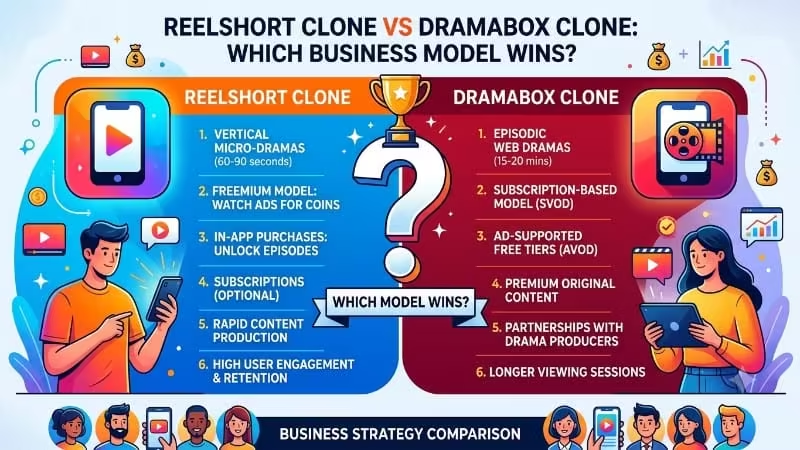
ReelShort Clone vs DramaBox Clone: Which Business Model Wins?
Two apps. Same format. Same coin wallets. Same cliffhangers engineered at the sixty-second mark. Same genre playbook built around billionaire CEOs, secret heiresses, and forbidden alphas. And yet one of them made $1.2 billion in gross consumer spending in 2025 while still burning cash, and the other made $323 million while turning a $10 million net profit. That gap — between a loss-making market leader and a profitable number-two — is not a size story or a luck story. It's a business model story. ReelShort and DramaBox look nearly identical to a viewer tapping through episodes on a Tuesday night. But underneath the coin wallets and the autoplay transitions, they are running fundamentally different strategies with fundamentally different risk profiles, fundamentally different geographic bets, and fundamentally different definitions of what success looks like. If you're building a clone of either platform, the most important decision you will make is not which technology stack to use or which white-label vendor to hire. It's which of these two business models you're actually copying — because they are not interchangeable, and trying to run both simultaneously without understanding what makes each one work is the fastest way to build something that has the costs of both and the advantages of neither. This article breaks down exactly what separates the two models, what each one costs to replicate, what each one requires operationally, and which one is more likely to work for a founder entering this market in 2026 rather than in 2022 when both platforms were still finding their footing. ---
The Scoreboard First — Because the Numbers Tell the Story
Before getting into strategy, here are the raw numbers, because they're the most honest starting point for this conversation. <cite index="12-1">ReelShort and DramaBox split roughly 70% of global short-drama in-app purchase revenue in Q1 2025, generating $130 million and $120 million respectively, according to Sensor Tower data.</cite> On the surface, those numbers look like a dead heat. They're not. <cite index="14-1">ReelShort grew from approximately $36 million in revenue in 2023 to roughly $1.2 billion in gross consumer spend in 2025, making it the highest-grossing vertical drama platform in the world.</cite> The trajectory is steep enough that it made TIME's 100 Most Influential Companies list in 2024 and earned a Paramount partnership that traditional media houses treat as a sign of legitimate content credibility. <cite index="14-1">DramaBox grew from $8 million in revenue in 2023 to $323 million in 2024, with a net profit of $10 million — making it the only major microdrama platform operating at scale that is actually in the black.</cite> Read those two data points side by side and the real tension in this comparison comes into focus. ReelShort is bigger, louder, and still losing money. DramaBox is smaller, quieter, profitable, and backed by the Disney Accelerator.
The ReelShort Model: Spend to Dominate, Monetize the Whales
ReelShort's business model is borrowed almost entirely from mobile gaming, and not the casual mobile game category. It mirrors the economics of high-stakes gacha games: a small percentage of users — referred to in gaming as "whales" — generate a disproportionate share of total revenue through high-frequency, high-value purchases, while the majority of users contribute minimally or nothing at all. <cite index="15-1">Peak ARPU (Average Revenue Per User) from ReelShort's most engaged users reaches $80 per month. Gross margins exceed 60%. But churn is brutal — over 50% of paying users drop off within a week. ReelShort compensates with relentless user acquisition, consistently ranking in the top 10 US entertainment downloads.</cite> That churn-and-acquire loop is the central operational reality of the ReelShort model, and it's what makes it simultaneously impressive and fragile. <cite index="15-1">User acquisition spend is estimated at 5 to 9 times the production budget, meaning ReelShort spends more on Facebook and TikTok ads than it does making shows.</cite> When "How to Tame a Silver Fox" was released in mid-2025, <cite index="18-1">ReelShort ran over 24,000 ad creatives in a single month, with that one series alone accounting for more than The geographic concentration makes this even more significant. <cite index="15-1">An estimated 90% of ReelShort's revenue comes from the United States alone, where revenue per download sits at approximately $4.70 — the highest of any market globally.</cite> That US concentration is the source of both ReelShort's revenue dominance and its greatest structural risk. If US user acquisition costs rise, if regulatory scrutiny on Chinese-owned apps intensifies, or if audience saturation in the billionaire romance genre finally sets in, ReelShort has limited geographic fallback. The content model reinforces this premium positioning. <cite index="12-1">ReelShort commissions all-original English-language productions in Los Angeles, buying content outright at $150,000 to $250,000 per 60-to-90-episode series with producer fees running 10 to 15%.</cite> The genre playbook is narrow and deliberately so: maximum dramatic intensity, billionaire and CEO romance, revenge arcs, supernatural twists, and cliffhangers engineered for episode-to-episode addiction. <cite index="14-1">"The Double Life of My Billionaire Husband" accumulated over 500 million views. "True Heiress vs. Fake Queen Bee" reached 395 million. "How to Tame a Silver Fox" hit 382 million.</cite> These are not coincidences of quality — they are the predictable output of a format optimized to convert emotional investment into coin purchases at scale. For a founder cloning this model, the implications are clear and expensive. You need a high-velocity content pipeline of premium, genre-specific originals. You need an aggressive and continuous user acquisition machine that operates at volumes most marketing budgets can't sustain. You need to be prepared to run at a loss for an extended period while building an audience large enough for the whale economics to generate meaningful revenue.
The DramaBox Model: Profitable Everywhere, Dominant Nowhere in Particular
DramaBox's business model is built on a completely different philosophical foundation: sustainable growth over market dominance, geographic diversification over premium concentration, and a content strategy that balances volume with variety rather than doubling down on a single genre formula. <cite index="15-1">DramaBox operates across 84 markets, with meaningful user bases in the US, Brazil, MENA, and Southeast Asia. No single market accounts for more than 40% of revenue. This geographic spread provides resilience that ReelShort's US-concentrated model does not — if the US vertical drama market faces saturation or regulatory headwinds, DramaBox is better positioned to absorb the shock.</cite> The monetization architecture differs from ReelShort's in one important way that changes the entire user economics. <cite index="15-1">DramaBox's weekly pass costs $19.99 for unlimited access, and the subscription model delivers more sustainable economics: lower churn than ReelShort, more predictable revenue, and proven unit economics.</cite> The coin system exists on DramaBox too, but the platform has invested more heavily in converting engaged viewers into subscribers rather than relying primarily on impulse coin purchases at emotional peaks. <cite index="15-1">Revenue per download varies dramatically by geography for DramaBox: $4.70 in the US, $0.73 in MENA, $0.27 in Latin America. This geographic RPD spread explains why DramaBox's 84-market strategy generates less per-user revenue than ReelShort's US-concentrated model, but diversifies risk considerably.</cite> It's a deliberate trade: lower average monetization per user in exchange for a global footprint that no regulatory action in any single country can significantly damage. The content strategy is wider and less prescriptive. DramaBox covers fantasy, supernatural content, slice-of-life narratives, and thriller alongside the standard billionaire romance that ReelShort has made its signature. <cite index="13-1">DramaBox's larger and more diverse content library appeals to viewers with varied tastes, and this approach has been more effective at rapid user acquisition in emerging markets, even if it sacrifices the kind of premium-audience concentration that drives ReelShort's per-user revenue.</cite> <cite index="12-1">DramaBox was selected for the 2025 Disney Accelerator program, and in April 2026 became the first short drama app with global programmatic ad inventory via The Trade Desk — opening its ad inventory to programmatic buyers worldwide and representing a strategic divergence from ReelShort's IAP-only path.</cite> That last point matters more than it might initially appear. Adding programmatic advertising as a revenue stream fundamentally changes DramaBox's unit economics, because it allows monetization of users who never purchase coins — the majority of any platform's audience — through ad revenue rather than requiring every monetization event to be a transaction. For a founder cloning this model, the operational requirements look quite different from the ReelShort playbook. You need wider content range rather than deep genre specialization. You need payment infrastructure that works across multiple countries and currencies, not just US-focused in-app purchases. You need a subscription model that converts engaged users away from per-episode impulse spending into predictable recurring revenue. And you need the patience to build across many markets simultaneously rather than concentrating resources on winning one market decisively. ---
Where the Two Models Visibly Diverge: Five Decision Points
Understanding the philosophy of each model is useful. Understanding exactly where the operational differences show up in practice is more useful. Here are the five decision points where a ReelShort clone and a DramaBox clone require genuinely different answers.
Content budget allocation. The ReelShort model demands premium, original, English-language productions at $150,000 to $250,000 per series, released at the pace of approximately one new show per day to maintain the content velocity that keeps churn at manageable levels. The DramaBox model allows a hybrid approach — original productions supplemented by licensed or translated content from partner studios — which reduces per-title costs and allows faster library growth without requiring equivalent production investment. A DramaBox clone can build a credible content library faster and more cheaply than a ReelShort clone, at the cost of the exclusive IP ownership that premium originals provide.
Geographic launch strategy. A ReelShort clone should launch in the US, UK, Canada, or Australia — the markets where the $4.70 revenue-per-download figure makes the high user acquisition costs economically viable. A DramaBox clone is better served by a multi-market soft launch strategy, testing content performance in lower-cost acquisition markets like Southeast Asia or Latin America before investing in the high-competition North American market. The ReelShort model requires expensive market dominance. The DramaBox model permits profitable market presence at smaller scale.
Monetization architecture. A ReelShort clone needs a coin economy optimized for impulse purchasing at emotional peaks — packages priced to maximize the frequency of the $1.99 to $9.99 purchase decision, wallet balances that always leave a small remainder to encourage the next top-up, and a paywall placement calibrated to hit exactly when emotional investment is highest. A DramaBox clone needs all of that plus a robust subscription conversion funnel, because the platform's unit economics improve significantly when viewers move from per-episode spending to weekly or monthly subscription plans with predictable revenue.
User acquisition philosophy.ReelShort runs at a user acquisition spend of 5 to 9 times its production budget, treating new user acquisition as a continuous, high-velocity machine rather than a launch-phase investment. DramaBox runs a more balanced spend between content and acquisition, partly because its multi-market strategy allows it to find lower cost-per-install in emerging markets and partly because its subscription model improves lifetime value enough to make each acquired user more economically viable. A ReelShort clone requires a marketing budget that most founders find uncomfortable before they've generated their first dollar of revenue. A DramaBox clone is more forgiving of a staged, lower-volume acquisition approach.
Risk profile.The ReelShort model carries concentration risk — geographic, regulatory, and genre-specific. If US user acquisition costs increase 30% due to competitive pressure, if a regulatory action targets the coin economy's subscription disclosure practices (and the FTC's 2025-2026 enforcement wave against subscription dark patterns creates real exposure for the entire category), or if viewer fatigue with the billionaire romance formula accelerates, the model's entire revenue base is at risk simultaneously. The DramaBox model distributes risk across 84 markets and multiple content genres, which means no single external shock can take down the business — but also means no single market success creates the kind of dominant revenue that ReelShort's US concentration produces.
📖 Read more blogs: Jorvea — Free Guest Blogging & Content Publishing Platform
John Wilson
Hi, I'm John Wilson, a Senior Data Analyst and Business AI Specialist with years of experience helping organizations transform raw data into actionable business insights. I specialize in AI-driven analytics, business intelligence, predictive modeling, and data visualization to support smarter, data-
Contributor at Jorvea — Free Guest Blogging & Content Publishing Platform
Frequently Asked Questions
Can I combine elements of both models — some original content, some licensed, coin purchases plus subscriptions?
You can, and in practice most successful platforms eventually do run a hybrid. The risk is that combining models without clearly prioritizing one creates operational and financial ambiguity — you're never lean enough to be profitable at DramaBox's scale and never premium enough to command ReelShort's per-user revenue. The practical answer for a launch-stage platform is to pick one model as your primary architecture and treat the other as a feature to add once you've proven the core economics. Most founders find that starting with the DramaBox model's hybrid content approach and multi-market flexibility, then adding higher-production original series and US market concentration as revenue grows, is a more survivable sequence than trying to run ReelShort's capital-intensive model from day one
ReelShort is loss-making despite $1.2 billion in revenue. How is that possible, and should it worry me?
It should inform your planning rather than worry you. ReelShort's losses are structural: the company is deliberately spending 5 to 9 times its production budget on user acquisition, operating on the assumption that building audience scale now creates a platform that becomes profitable once user acquisition costs stabilize and lifetime value compounds. This is the same bet Netflix made for years before its economics improved. The question for a clone founder is whether you have the funding and timeline to sustain that same strategy, and the honest answer for most founders is no. DramaBox's profitability with lower revenue is a more instructive benchmark for most new entrants — it shows the model can work economically without requiring ReelShort's scale.
Which geography should I prioritize when launching?
The ReelShort model demands North America first, because the $4.70 revenue per download figure that makes the high user acquisition costs viable exists primarily in the US, Canada, UK, and Australia. The DramaBox model permits a wider geographic entry — and actually benefits from launching in lower-cost-per-install markets like Southeast Asia, Brazil, or MENA first, where content can be validated and monetization refined before competing in the more expensive North American market. Your geographic decision should follow directly from which model you've committed to, not precede it.
Is the billionaire CEO romance formula saturating, or does it still have runway?
The genre has been dominant since ReelShort's earliest viral hits, but there are real signs of formula fatigue at the fringes — the 2025 IP plagiarism scandal involving multiple Chinese studios accusing each other of near-identical series reflects the pressure the format is creating in content development pipelines. The most interesting opportunity for a new entrant is precisely in the genre gaps the dominant platforms are underserving: thriller content is achieving retention rates roughly 40% higher than traditional romance, horror is an emerging category with engaged early audiences, and slice-of-life content with local cultural specificity is consistently outperforming adapted-for-the-US content in European and emerging markets. The billionaire romance formula isn't dead, but it's also no longer a differentiation strategy — it's a baseline.
_1782719692121.jpeg&w=1200&q=75)