The Real Cost of Building Vertical Drama Streaming Platform
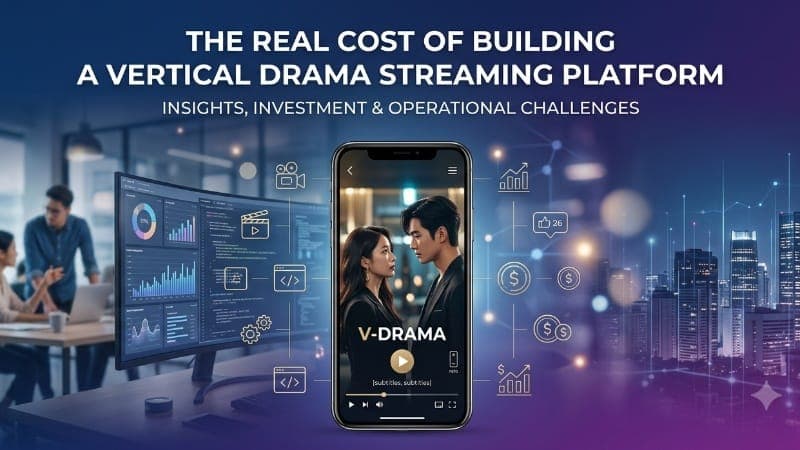
A few years ago, most streaming platforms competed by offering longer movies, television series, and exclusive originals. Today, the landscape is changing. Millions of users are choosing short-form, mobile-first entertainment that fits into their daily routines. Whether waiting for a cab, taking a coffee break, or relaxing before bed, viewers increasingly prefer stories they can enjoy in just a few minutes. This shift has given rise to one of the fastest-growing segments of the entertainment industry—vertical drama streaming platforms.
Unlike traditional OTT applications, vertical drama platforms are designed specifically for smartphones. Every episode is filmed in portrait mode, optimized for one-handed viewing, and crafted to keep users engaged from the first scene to the last. The combination of bite-sized storytelling, AI-powered recommendations, personalized viewing experiences, and flexible monetization has transformed vertical drama apps into attractive business opportunities for startups, media companies, production houses, and entrepreneurs alike.
However, behind every successful platform lies a carefully planned investment. Many founders assume that building a streaming app is simply a matter of designing an interface and uploading videos. The reality is far more complex. A professional vertical drama platform requires high-performance video streaming infrastructure, secure backend architecture, intelligent recommendation systems, scalable cloud services, payment integrations, user analytics, and continuous maintenance.
This is why one of the first questions investors and business owners ask is:
What is the real cost of building a vertical drama streaming platform?
The answer goes far beyond a single price tag. The total investment depends on your business goals, feature requirements, technology choices, content strategy, target audience, scalability plans, and post-launch operations.
This comprehensive guide explains every major factor that influences development costs, highlights hidden expenses many businesses overlook, and provides practical budgeting insights to help you make informed investment decisions.
Why Is the Vertical Drama Market Growing So Quickly?
The rapid growth isn't accidental.
Several consumer behavior trends have contributed to the popularity of vertical streaming platforms.
Smartphone-First Consumption
More than 70% of online video consumption now occurs on smartphones. Users increasingly prefer entertainment that fits into short breaks throughout the day rather than committing to hour-long shows.
Vertical videos eliminate the need to rotate devices, offering a more natural viewing experience.
Shorter Attention Spans
Modern audiences expect instant entertainment. Short episodes create a sense of continuous progression, making it easier for viewers to consume dozens of episodes in a single session.
Social Media Influence
Platforms like TikTok, Instagram Reels, and YouTube Shorts have conditioned users to consume vertical content.
Vertical drama platforms simply extend this viewing habit into serialized storytelling.
High User Engagement
Because each episode ends with a cliffhanger, users are more likely to continue watching, increasing session duration, retention, and revenue.
Why There Is No Fixed Cost for Building a Vertical Drama Streaming Platform
Many business owners begin their research expecting to find a standard price for app development. Unfortunately, software development does not work that way. Unlike purchasing a ready-made product, building a streaming platform is a customized process where every feature, integration, and technical decision contributes to the final investment.
Imagine two businesses planning to launch vertical drama apps. One company wants to release a simple platform with a limited content library for a regional audience. Another aims to build an international streaming service with multilingual support, AI-powered recommendations, subscription management, and cloud infrastructure capable of handling millions of users. Although both projects fall under the same category, their development requirements are entirely different.
This is why experienced development teams focus first on understanding business objectives rather than immediately discussing pricing. The clearer your vision is, the easier it becomes to estimate the resources, technologies, and timeline required for development.
A realistic budget should never be based solely on the question, "How much does an app cost?" Instead, it should answer a more valuable question: "What kind of platform do we want to build, and what investment is required to achieve that vision?"
Your Business Vision Shapes the Overall Investment
Before discussing technology, it's essential to define the purpose of your streaming platform. Every business enters the market with different goals. Some want to validate a new business idea, while others plan to compete directly with established entertainment platforms.
If your objective is to launch quickly and test user interest, your investment strategy will naturally differ from a company building a large-scale commercial platform with advanced personalization and premium content.
Business goals also influence decisions related to monetization, user acquisition, content licensing, localization, and future expansion. A platform targeting one country requires a different technical approach than one preparing for international audiences with multiple languages and payment methods.
When development begins with clearly defined objectives, budgeting becomes far more accurate because every investment supports a measurable business outcome rather than unnecessary functionality.
The Features You Choose Determine More Than Just Cost
One of the biggest factors affecting development costs is the feature set. However, businesses often misunderstand this relationship. More features do not automatically create a better product. In many cases, simplicity leads to a stronger user experience and a faster route to market.
A successful vertical drama platform focuses first on delivering an enjoyable viewing experience. Users expect fast registration, smooth navigation, reliable streaming, personalized recommendations, and secure subscription management. These core capabilities create the foundation of the application.
As the platform grows, additional features can be introduced based on actual user behavior. Interactive comments, referral programs, offline downloads, AI-driven recommendations, multilingual subtitles, and loyalty programs are valuable additions, but they should support business growth rather than delay the initial launch.
This phased approach allows businesses to control costs while continuously improving the platform according to real customer feedback.
Why Asking "How Much Does It Cost?" Is the Wrong Starting Point
One of the first questions founders ask during the planning phase is, "How much will it cost to build my vertical drama platform?" No experienced architect would answer immediately because the cost depends on dozens of decisions. The number of rooms, construction materials, location, interior design, energy systems, and future expansion plans all influence the final investment.
Developing a vertical drama streaming platform follows the same principle.
Two applications may appear almost identical to users, yet their underlying architecture can be dramatically different. One platform might be designed for a few thousand active users with a limited content library, while another is built to support millions of viewers, deliver high-definition streaming worldwide, process thousands of simultaneous subscription payments, and provide personalized recommendations in real time.
Although both applications serve the same purpose, the engineering effort behind them is vastly different.
This is why experienced software development companies spend considerable time understanding a client's business before discussing budgets. They evaluate the project's goals, target audience, expected user growth, monetization strategy, content management requirements, and long-term roadmap. Only after these factors are understood can a realistic cost estimate be prepared.
Businesses that skip this discovery stage often underestimate their investment, leading to budget overruns, delayed launches, or compromises in product quality. A successful streaming platform is not built by guessing costs—it is built by understanding the relationship between business objectives and technical requirements.
For founders, this represents an important shift in mindset. Instead of asking, "How much does the app cost?", the better question becomes:
"What kind of streaming platform am I trying to build, and what investment is required to support that vision?"
That single change in perspective leads to far better planning decisions and a more sustainable development strategy.
Every Business Requirement Creates a Technical Requirement
One of the biggest reasons development costs vary is that every business decision eventually becomes a technical requirement.
For example, imagine you want users to receive personalized recommendations after watching several episodes. From a business perspective, this sounds like a simple feature designed to increase engagement. From a development perspective, however, it introduces an entirely new layer of complexity.
The platform must collect user behavior, record viewing history, analyze watch duration, identify genre preferences, process engagement patterns, store large amounts of behavioral data, and use intelligent algorithms to generate relevant recommendations. That information must then be delivered instantly every time a user opens the application.
Similarly, offering offline viewing may appear to be a straightforward convenience for viewers, but implementing it requires secure video encryption, local storage management, download optimization, digital rights protection, storage monitoring, synchronization between devices, and mechanisms that prevent unauthorized sharing of premium content.
Even something as familiar as a "Continue Watching" section involves much more than displaying a thumbnail. The application must remember exactly where every user stopped watching, synchronize that information across multiple devices, update playback progress continuously, and restore the video without delay whenever the user returns.
This illustrates an important principle in software budgeting: users pay for experiences, but businesses invest in the systems that make those experiences possible.
Understanding this relationship helps founders appreciate why professional streaming platforms require thoughtful planning rather than simplistic pricing estimates.
Conclusion
Building a vertical drama streaming platform is a significant investment, but it also presents one of the most promising opportunities in today's digital entertainment landscape. As mobile-first viewing continues to dominate and audiences increasingly favor short, engaging video content, vertical drama apps have emerged as a high-growth segment with strong revenue potential.
The overall development cost depends on several factors, including the platform's feature set, streaming infrastructure, content management capabilities, AI-driven personalization, payment integration, and scalability requirements. While a basic MVP can be launched with a relatively modest budget, creating a competitive platform that delivers a seamless user experience and supports long-term growth requires strategic planning and investment.
Beyond development, businesses should also account for ongoing expenses such as cloud hosting, content production or licensing, platform maintenance, marketing, customer support, and continuous feature enhancements. These recurring costs play a crucial role in ensuring platform performance, user retention, and sustained profitability.
Ultimately, success in the vertical drama industry is not determined solely by how much you spend but by how wisely you invest. A well-designed platform, combined with compelling original content, intuitive user experience, reliable streaming technology, and an effective monetization strategy, can establish a strong competitive advantage in this rapidly expanding market.
Whether you're a startup looking to launch an MVP or an established media company planning a large-scale OTT platform, understanding the real cost of building a vertical drama streaming platform is the first step toward making informed decisions and maximizing your return on investment. With the right technology partner and a scalable development roadmap, you can build a platform that not only meets today's audience expectations but is also prepared for the evolving future of short-form digital entertainment.
(Continued in Part 2 with team structure, development timeline, budgeting strategies, cost optimization techniques, conclusion, and reader-focused FAQs.)
📖 Read more blogs: Jorvea — Free Guest Blogging & Content Publishing Platform
John Wilson
Hi, I'm John Wilson, a Senior Data Analyst and Business AI Specialist with years of experience helping organizations transform raw data into actionable business insights. I specialize in AI-driven analytics, business intelligence, predictive modeling, and data visualization to support smarter, data-
Contributor at Jorvea — Free Guest Blogging & Content Publishing Platform
Frequently Asked Questions
What factors have the biggest impact on the cost of building a vertical drama streaming platform?
The overall cost depends on several factors, including app complexity, supported platforms, video streaming infrastructure, UI/UX design, backend architecture, AI-powered features, cloud hosting, security, and long-term maintenance.
Is it better to build an MVP before launching a full-featured platform?
Yes. Launching an MVP allows businesses to validate their idea, gather user feedback, reduce initial investment, and prioritize future features based on real user behavior.
Why is video streaming infrastructure considered one of the largest investments?
Streaming platforms require secure cloud storage, content delivery networks, adaptive bitrate streaming, video encoding, playback optimization, and bandwidth management. These services involve both development and ongoing operational costs.
. How do AI features influence development costs?
AI capabilities such as personalized recommendations, smart search, viewer behavior analysis, and predictive analytics increase development complexity but improve engagement, retention, and user satisfaction.
What hidden costs do businesses often overlook?
Common hidden expenses include cloud hosting, CDN usage, API subscriptions, app store accounts, security monitoring, analytics platforms, customer support software, software licenses, and ongoing maintenance.