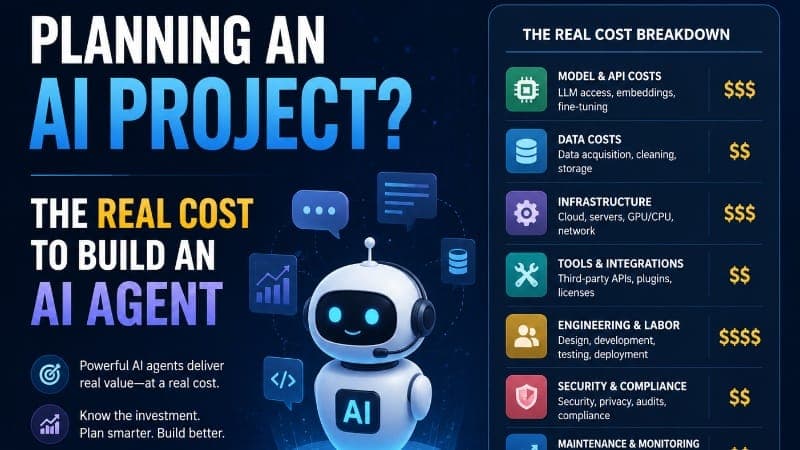
Planning an AI Project? | The Real Cost to Build an AI Agent
Introduction
Planning an AI project is exciting, but it can also feel overwhelming. Businesses often hear success stories about AI improving customer support, increasing productivity, and automating repetitive work. At the same time, they also hear about projects that exceeded their budgets or took much longer than expected.
This leaves many business owners asking the same question before they Every business is different, and every AI project is built around unique goals. Some companies only need a virtual assistant to answer customer questions, while others want an AI system that communicates with multiple departments, analyzes business data, and automates everyday operations.
Think about opening a new business location. A small neighborhood café and a large shopping mall both require planning, but the amount of work, resources, and investment involved is completely different. The same principle applies to AI development.
Instead of looking for a fixed number, businesses should understand what actually influences the budget. Knowing these factors before development begins helps avoid unexpected costs and allows companies to make smarter investment decisions.
In this guide, we'll explain the biggest factors that influence AI project costs using practical examples and simple language, making it easier to plan your next AI project with confidence.
Start With Clear Business Goals Before Discussing Budget
Before discussing the Cost to build an ai agent, businesses should first understand what they want the AI to achieve. This may sound obvious, but it is one of the most overlooked parts of planning.
Many companies begin with a simple idea.
"We want an AI assistant."
Although that sounds like a complete plan, developers still need answers to several important questions before they can estimate the project accurately.
Some of the questions include:
What business problem will the AI solve?
Who will use it every day?
Should it support customers, employees, or both?
Does it provide information or perform business tasks?
These answers define the size of the project.
Let's compare two examples.
An AI assistant for a local real estate agency would be needed to answer questions about properties, schedule appointments, and gather customer information prior to contacting a sales agent.
Think now of an international logistics company whose AI assistant would need to manage shipments, coordinate with warehouse management systems, produce reports, help out in customer service, and control deliveries in real time.
Despite the fact that both firms require an AI agent, the second project implies more complex preparation and development.
One of the common mistakes that many businesses make is getting quotations without specifying what they want to achieve through their project. That is why various companies develop different quotes.
When business goals are clear from the beginning, developers can recommend practical solutions instead of building unnecessary features.
Tip: Spend time defining business objectives before discussing budgets. A clear roadmap usually saves both time and money throughout the project.
Your Users Shape the Type of AI You Need
One factor that many businesses underestimate is the people who will actually use the AI.
Top-rated app development often becomes an important part of AI projects because the AI itself is only one part of the customer experience. Businesses also need a reliable way for customers and employees to interact with the system.
Imagine a company launching an AI shopping assistant.
If customers only access it through the company website, development remains fairly straightforward.
Now imagine the same AI being available through:
A mobile application
A customer dashboard
A sales team's internal portal
Live chat
Voice support
The AI may perform similar tasks, but developers now need to build multiple user experiences that work smoothly across different platforms.
The number of users also affects development decisions.
An AI system serving twenty employees has very different technical requirements than one supporting thousands of customers every day.
Larger systems often require stronger infrastructure, faster response times, better security, and additional testing to ensure the AI performs reliably during busy periods.
Accessibility is another important consideration.
Some users prefer typing, while others expect voice conversations. Businesses operating internationally may also need multiple language support to provide a consistent experience for customers in different regions.
Planning for these requirements early prevents expensive redesigns after launch.
Think about building a hotel.
Designing rooms for twenty guests is very different from designing a hotel that welcomes hundreds of visitors every day. The same idea applies when planning AI systems.
Warning: Underestimating the number of users or platforms often leads to higher upgrade costs later because the original system wasn't designed for future growth.
Business Data Is Just as Important as AI Technology
The majority of business owners think that the AI model is the crucial element of the project.
However, in most cases, the quality of business data may affect the final outcome much more than the AI itself. In order to offer correct solutions, the AI agent requires high-quality data.
Think about the case when you need to ask the AI assistant for making product recommendations. In this case, the AI agent will make its decisions based on the information provided. But if the data is outdated or incorrect, then nothing can help. The same challenge exists across almost every industry.
Customer records may contain duplicate information. Product catalogs may not be updated regularly. Internal documents may exist in different formats across multiple departments. Before development begins, businesses often need to organize this information so the AI has a reliable foundation.
This process may seem like extra work, but it often improves the quality of the final AI solution far more than adding another feature.Think about hiring a new employee.
Before expecting excellent performance, you provide proper training, accurate documents, and clear instructions. AI requires exactly the same preparation.
Common Problem: Many businesses budget for AI development but forget to budget for preparing and organizing their existing business data.
Choosing the Right Features Prevents Unnecessary Spending
After setting clear business goals and preparing your data, the next step is deciding what your AI agent should actually do.
Many businesses make the mistake of trying to build every possible feature before launching the project. While this sounds like a good idea, it often leads to longer development times, larger budgets, and delays that could have been avoided.
Adult aI agent development is a good example of how feature planning can quickly become more complex. Businesses in this industry often require user verification, privacy protection, content moderation, personalized recommendations, and secure communication. Each of these features adds value, but each one also requires additional development, testing, and ongoing maintenance.
The same situation happens in many other industries. Let's imagine an online education platform. The business initially wants an AI assistant that answers student questions about courses.
As discussions continue, new ideas begin to appear.
Recommend learning paths.
Schedule live classes.
Generate certificates.
Send assignment reminders.
Provide personalized study tips.
Support multiple languages.
Every feature sounds useful, but together they significantly increase the size of the project.
Businesses often focus on the customer experience without realizing how much work happens behind the scenes. Developers need to build new workflows, connect additional systems, test different situations, and make sure every feature works smoothly with the rest of the platform.
A smarter approach is to identify the features that solve the biggest business problems first. Once the AI is being used by customers or employees, additional features can be introduced based on real feedback rather than assumptions.
This approach usually delivers faster results while keeping development costs under control.
Tip: Launch with features that create immediate business value. Additional improvements can always be added after users begin interacting with the AI.
Planning Before Development Usually Reduces Overall Costs
Many businesses spend weeks comparing development companies without spending enough time planning the project itself.
Price is important, but planning has a much bigger influence on the final budget. Imagine two companies opening new retail stores. The first company carefully plans the store layout, customer flow, storage areas, and future expansion before construction begins.
The second company starts building immediately and changes the design every few weeks. Although both stores eventually open, the second project usually costs much more because completed work has to be redesigned and rebuilt several times.
AI development follows exactly the same pattern. When businesses clearly define their goals before coding starts, developers can build the right solution from the beginning. This reduces unnecessary revisions, prevents misunderstandings, and creates more accurate timelines.
Good planning also helps answer questions such as:
Which features are essential for launch?
Which systems should the AI connect with?
How many users will access the AI?
What business results should the project achieve?
Answering these questions early allows developers to recommend practical solutions instead of making assumptions.
Many experienced technology companies, including Triple Minds, encourage businesses to begin with discovery sessions before development starts. These discussions help identify priorities, estimate realistic budgets, and create a roadmap that everyone understands.
Another popular strategy is launching a Minimum Viable Product (MVP). Instead of waiting until every feature is complete, businesses release the most important functionality first. After collecting feedback from real users, they continue improving the AI based on actual business needs.
This approach reduces risk while helping businesses invest in features that deliver measurable value.
Warning: Constantly changing project requirements during development almost always increases both project costs and delivery time.
An AI Project Continues Long After Launch
Indeed, many believe that releasing the AI agent signifies the completion of the project.
However, this is just the beginning of the next phase of development. Companies keep on evolving over time. There are new products coming out, customer needs become more complex, employees learn how to do their jobs better, and software undergoes constant updates.
AI agents have to evolve along with the company. Take, for example, a restaurant business model. Its physical infrastructure might already be built, but the company keeps on evolving every month.
An AI system requires the same ongoing attention. After launch, businesses often discover new opportunities for automation. Customer support teams may want additional features. Sales departments may request lead qualification. Managers may need new reports or performance insights.
Instead of rebuilding the AI from scratch, developers can continue improving the existing solution over time. Regular maintenance also helps keep the AI secure, accurate, and compatible with other business software as technology evolves. Businesses that plan for continuous improvement usually receive far greater long-term value from their investment than those that treat AI as a one-time purchase.
Working with experienced technology partners like Triple Minds also makes future enhancements easier because the AI is designed to support business growth from the beginning.
Common Problem: Many businesses only budget for development and overlook the ongoing updates that keep an AI solution useful and competitive.
Conclusion
Planning an AI project is about much more than finding a development price. The final investment depends on your business goals, the people who will use the AI, the quality of your existing data, the features you choose, and the amount of planning completed before development begins.
Businesses that take time to understand these factors usually make better investment decisions because they focus on solving real business problems instead of simply comparing quotations.
A well-planned AI project not only controls costs but also creates a solution that continues delivering value as the business grows. By starting with clear objectives, launching essential features first, and improving the system over time, businesses can build AI solutions that provide long-term benefits rather than short-term results.
📖 Read more blogs: Jorvea — Free Guest Blogging & Content Publishing Platform
Thomas - Digital Workflow
👋 Hi, I'm Thomas, a former Web Developer 💻 now specializing in SEO 🚀. I share practical SEO strategies 🔍, AI business trends 🤖, digital marketing insights 📈, and the latest tech updates 🌐 to help businesses and professionals stay ahead online.
Contributor at Jorvea — Free Guest Blogging & Content Publishing Platform
Frequently Asked Questions
1. Why is it difficult to estimate an AI project before planning?
Every business has different goals, workflows, users, and software systems. Developers need to understand these details before providing an accurate estimate.
2. What increases the cost of an AI project the most?
Project scope, required features, software integrations, business data preparation, and industry-specific requirements are usually the biggest cost factors.
3. Is it better to build every feature before launch?
No. Most successful businesses launch the essential features first and expand the AI after receiving feedback from real users.
4. Why is business data important for AI?
AI depends on accurate information. Well-organized business data helps the AI provide better answers, automate tasks correctly, and improve overall performance.
5. Does AI require maintenance after launch?
Yes. Regular updates improve security, accuracy, and performance while allowing the AI to adapt as the business grows.