Insurance Compliance Software vs. AI Policy Analysis
The insurance industry is experiencing one of its biggest transformations in decades. Regulatory requirements are becoming more stringent, customer expectations are evolving, and organizations are expected to make faster, more accurate decisions while managing increasingly complex policy documents. As insurers, brokers, and enterprises navigate this landscape, two technologies have emerged as critical enablers: Insurance compliance software and AI-powered insurance policy analysis.
While these solutions are often discussed together, they serve different purposes. One ensures organizations remain compliant with industry regulations, while the other unlocks insights from insurance documents to improve decision-making. The question many businesses are asking today is: Do you need one or both?
The answer depends on your operational goals, risk exposure, and digital transformation strategy. However, for organizations preparing for the future, combining both technologies often delivers the greatest value.
Understanding Insurance Compliance Software
Insurance regulations continue to evolve across industries and jurisdictions. Organizations must adhere to numerous legal, financial, and operational requirements while maintaining accurate records and audit trails.
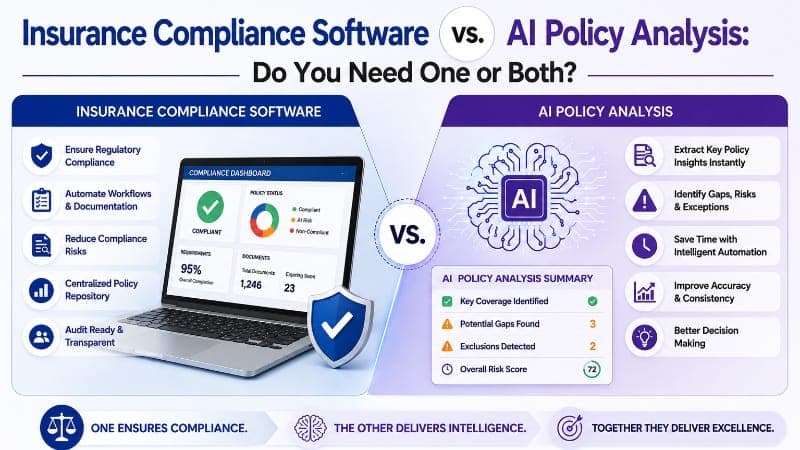
Insurance compliance software is designed to simplify and automate these compliance processes. It helps organizations monitor regulatory obligations, maintain documentation, track policy changes, generate compliance reports, and reduce the risk of violations.
Key capabilities typically include:
- Regulatory monitoring and updates
- Automated compliance workflows
- Audit-ready documentation
- Risk assessment and reporting
- Policy lifecycle management
- Internal governance tracking
Rather than relying on spreadsheets or manual reviews, compliance software creates a centralized environment where organizations can consistently meet regulatory standards while reducing administrative effort.

What is AI-Powered Insurance Policy Analysis?
Unlike compliance software, insurance policy analysis focuses on understanding the actual content of insurance documents.
Insurance policies often contain hundreds of pages filled with endorsements, exclusions, conditions, riders, definitions, and legal terminology. Reviewing these documents manually is time-consuming and prone to human error.
Modern AI solutions can:
- Extract key policy clauses
- Identify exclusions and coverage limitations
- Detect missing information
- Highlight inconsistencies
- Compare policies side-by-side
- Generate concise summaries
- Answer questions based on policy content
Instead of spending hours reviewing documents manually, underwriting teams, brokers, legal professionals, and risk managers receive actionable insights almost instantly.
The Rise of the Insurance Policy Comparison Tool
One of the most practical applications of AI is the insurance policy comparison tool.
Organizations frequently compare:
- Multiple carrier quotes
- Renewal policies
- Legacy vs. updated contracts
- Vendor insurance certificates
- Customer coverage options
- Global insurance programs
Traditionally, comparing policies meant reviewing hundreds of clauses line by line.
AI changes this process completely.
An intelligent insurance policy comparison tool automatically identifies:
- Coverage differences
- Premium variations
- Policy exclusions
- Added or removed clauses
- Limits and deductibles
- Regulatory inconsistencies
This enables insurance professionals to make informed decisions faster while significantly reducing review time.
Insurance Compliance Software vs. AI Policy Analysis
Although both technologies improve operational efficiency, they solve different business problems.
|
Insurance Compliance Software |
AI Insurance Policy Analysis |
|
Focuses on regulatory compliance |
Focuses on understanding policy content |
|
Tracks legal obligations |
Extracts information from documents |
|
Supports audits |
Supports policy reviews |
|
Automates compliance workflows |
Automates document analysis |
|
Reduces regulatory risk |
Improves coverage understanding |
|
Maintains governance |
Enables intelligent policy comparison |
Think of compliance software as ensuring your organization follows the rules, while AI policy analysis helps you understand what your insurance policies actually say.
One manages compliance processes.
The other enhances decision intelligence.
Why Businesses Are Increasingly Adopting Both?
The insurance industry is shifting toward intelligent automation rather than isolated software solutions.
Consider a multinational organization renewing insurance coverage across multiple regions.
The compliance team needs to ensure every policy satisfies local regulatory requirements.
Meanwhile, the risk management team wants to verify that new policies provide equal or better coverage than existing ones.
Using only compliance software leaves gaps in policy interpretation.
Using only AI policy analysis may overlook regulatory obligations.
Together, they create a comprehensive risk management ecosystem where compliance, governance, and policy intelligence work seamlessly.
Current Industry Challenges
Today's insurance ecosystem presents several challenges that traditional processes struggle to address.
Increasing Policy Complexity
Modern insurance contracts are becoming increasingly sophisticated, with customized endorsements, cyber coverage extensions, environmental clauses, and jurisdiction-specific language.
Manual review no longer scales effectively.
Regulatory Changes
Insurance regulations continue to evolve across countries and industries, making compliance a significant challenge for insurance companies. Regulatory authorities frequently introduce new rules, reporting standards, and consumer protection requirements that organizations must follow. Insurance providers need to continuously monitor these changes, update internal policies, and modify their operational processes without disrupting daily business activities. Failure to comply with regulatory requirements can result in financial penalties, legal consequences, reputational damage, and loss of customer trust. By adopting advanced compliance management systems, automation tools, and regular employee training, organizations can efficiently adapt to regulatory changes while maintaining operational efficiency, reducing compliance risks, and ensuring consistent, high-quality service for their customers.
Rising Customer Expectations
Customers expect faster policy issuance, quicker claims processing, and transparent communication. Customers today expect insurance providers to deliver services that are fast, efficient, and transparent. They want policies to be issued quickly without lengthy paperwork or unnecessary delays. During the claims process, customers expect timely assessments, faster approvals, and prompt settlements, especially during emergencies when financial support is critical. Transparent communication is equally important, with customers seeking regular updates, clear explanations of policy terms, and easy access to claim status through digital platforms. In addition, they value personalized services, self-service options, and responsive customer support available through mobile apps, websites, or chatbots. Meeting these expectations not only improves customer satisfaction but also strengthens trust, enhances the overall customer experience, and increases customer loyalty in a highly competitive insurance industry. Organizations that embrace digital technologies and customer-centric practices are better positioned to meet these evolving demands and maintain a competitive advantage.
AI accelerates these processes while compliance software ensures they remain compliant.
Operational Efficiency
Organizations are under pressure to reduce operational costs without increasing risk.
Automation enables teams to review more policies with greater consistency and fewer manual errors.
Looking Toward the Future
The future of insurance is not simply digital, it is intelligent.
Artificial Intelligence is rapidly moving beyond document extraction into predictive decision support.
Future AI-powered insurance policy analysis platforms will likely:
- Predict potential coverage gaps before policy issuance
- Recommend policy improvements based on business profiles
- Automatically identify emerging regulatory risks
- Generate compliance recommendations
- Monitor policy changes in real time
- Support conversational policy search using natural language
At the same time, insurance compliance software will become increasingly integrated with AI capabilities, creating unified platforms that combine compliance management with intelligent document analysis.
Instead of operating as separate systems, businesses will benefit from connected ecosystems where policy intelligence, compliance monitoring, and risk management work together seamlessly.
Choosing the Right Solution
When evaluating technology investments, organizations should first identify their biggest operational challenges.
If regulatory audits, governance, and legal compliance consume significant resources, investing in robust insurance compliance software is a logical priority.
If policy reviews, coverage comparisons, or document analysis create operational bottlenecks, AI-powered insurance policy analysis can deliver immediate productivity gains.
However, organizations undergoing digital transformation should consider adopting both solutions as complementary technologies rather than competing alternatives.
Together, they provide:
- Better regulatory compliance
- Faster policy reviews
- Reduced operational risk
- Improved decision-making
- Greater transparency
- Enhanced customer service
- Scalable automation
Final Thoughts
The debate between Insurance compliance software and AI-powered insurance policy analysis is not about choosing one over the other. They address different challenges within the insurance lifecycle, and together they create a more resilient, efficient, and intelligent insurance operation.
As regulations become more complex and insurance documents continue to grow in volume and sophistication, businesses need technologies that not only ensure compliance but also deliver meaningful insights from policy data.
An advanced insurance policy comparison tool empowers organizations to evaluate coverage with greater speed and accuracy, while comprehensive insurance policy analysis transforms static documents into actionable intelligence. Combined with modern Insurance compliance software, these capabilities help organizations reduce risk, improve operational efficiency, and make better-informed decisions.
The future of insurance belongs to organizations that embrace both compliance automation and AI-driven policy intelligence, not as separate investments, but as complementary pillars of a smarter, more agile insurance ecosystem.
Conclusion
As the insurance industry continues to evolve, organizations can no longer rely on traditional, manual approaches to manage compliance and interpret complex policy documents. Insurance compliance software provides the structure and governance needed to meet regulatory requirements, while AI-driven insurance policy analysis delivers the speed, accuracy, and intelligence required to understand policies, identify risks, and make informed decisions. Together with an advanced insurance policy comparison tool, these technologies enable businesses to streamline operations, minimize compliance risks, and gain deeper insights into policy coverage.
Rather than viewing compliance software and AI policy analysis as competing solutions, forward-thinking insurers, brokers, and enterprises should see them as complementary investments that strengthen every stage of the insurance lifecycle. As AI capabilities continue to advance and regulatory landscapes become more dynamic, organizations that integrate both technologies will be better equipped to improve efficiency, enhance customer experiences, and build a more resilient, future-ready insurance ecosystem.
📖 Read more blogs: Jorvea — Free Guest Blogging & Content Publishing Platform
David Fenton
Contributor at Jorvea — Free Guest Blogging & Content Publishing Platform
Frequently Asked Questions
Why Businesses Are Increasingly Adopting Both
The insurance industry is shifting toward intelligent automation rather than isolated software solutions. Consider a multinational organization renewing insurance coverage across multiple regions.
What is AI-Powered Insurance Policy Analysis?
Unlike compliance software, insurance policy analysis focuses on understanding the actual content of insurance documents.
Why is faster policy issuance important in the insurance industry?
Faster policy issuance improves customer satisfaction by reducing waiting times and providing immediate coverage. It also enhances the customer experience, increases operational efficiency, and gives insurance companies a competitive advantage in the market.
How do insurance companies stay compliant with changing regulations?
Insurance companies stay compliant by continuously monitoring regulatory updates, implementing compliance management systems, conducting regular audits, training employees, and using automation to update processes and reporting requirements efficiently.
_1779434425740.png&w=1200&q=75)