

Autism Self-Assessment Test: What Your Results Really Mean
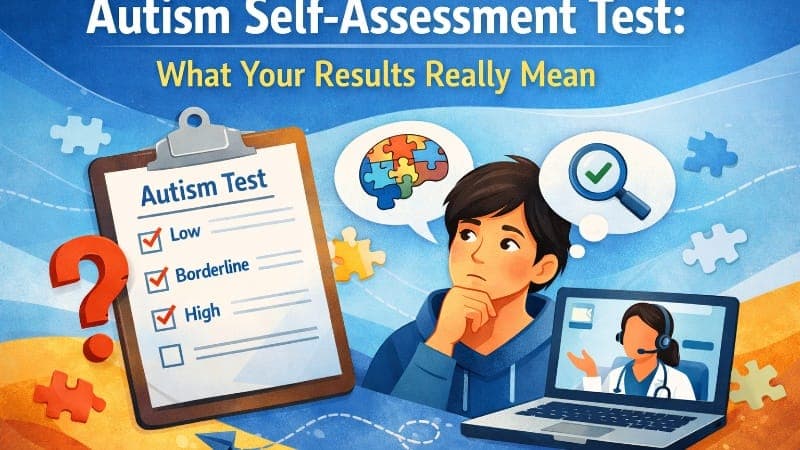
If you’ve recently taken an Autism Test online, you’re probably trying to make sense of your score and what it actually says about you. In Australia, especially with the rise of telehealth services like HelloDoc, more people are using autism self-assessments as a first step toward understanding neurodivergence. But the truth is, these results are often misunderstood.
This guide breaks down what an Autism Test really measures, how to interpret your results, and, most importantly, what they do not tell you.
What Is an Autism Self-Assessment Test?
An autism self-assessment test is a questionnaire designed to identify traits commonly associated with Autism Spectrum Disorder (ASD). These tests are often based on tools like:
Autism Spectrum Quotient (AQ)
RAADS-R screening
Other trait-based questionnaires
They typically measure areas such as:
Social communication patterns
Sensory sensitivities
Repetitive behaviours or routines
Focused interests
Emotional and cognitive processing styles
However, these tools are screening instruments, not diagnostic tools. They are designed to highlight traits that may suggest autism, not confirm it.
Research shows that tools like RAADS-R and AQ are best used as preliminary indicators rather than final answers, especially when used without clinician support.
Why People Take an Autism Test Online
There are several reasons people turn to online Autism Tests, particularly in Australia, where access to formal assessments can be expensive or have long wait times:
To better understand lifelong social or sensory differences
To explore possible neurodivergence (including ADHD overlap)
To prepare for a clinical autism assessment
To validate personal experiences that never “fit” mainstream expectations
To seek clarity through telehealth pathways
Online screening can be a helpful first step, but it should never be treated as a final diagnosis.
Understanding Your Autism Test Results
When you receive a score, it can feel like a clear answerbut it isn’t.
Most autism screening tools fall into general patterns:
1. Low or Below-Threshold Score
This usually means your responses did not strongly match common autistic trait patterns. However:
It does NOT rule out autism
Masking or learned social behaviour can affect results
Some autistic people score below thresholds, especially if they adapt socially over time
2. Borderline or Mid-Range Score
This is where many people feel confused.
A borderline result may indicate:
Some autistic traits are present
Possible overlap with ADHD, anxiety, or trauma
Mixed neurodevelopmental traits
This range is not uncommon and is often where clinical evaluation becomes important.
3. High or Above-Threshold Score
A high score suggests that your responses strongly align with patterns seen in autistic individuals.
However, it is crucial to understand:
It is not a diagnosis
It may reflect other conditions with overlapping traits (like ADHD or social anxiety)
It is a signal for further assessment, not confirmation
Even high-scoring individuals require a full clinical evaluation for diagnosis.
Why Autism Tests Can Be Misleading
Self-assessment tools have important limitations:
1. They rely on self-perception
Many questions ask you to judge your own behaviour, which can be difficult if you’ve spent years adapting or masking traits.
2. Symptom overlap with other conditions
Autism traits can overlap with:
ADHD
Anxiety disorders
PTSD
OCD
Depression
This overlap can sometimes inflate scores even when autism is not present.
3. Context matters
These tests do not consider:
Your developmental history
Childhood behaviour patterns
Clinical observation
Family input
That’s why professionals never rely on screening tools alone.
What Your Results Actually Mean (In Real Life Terms)
Instead of asking, “Am I autistic?” based on a score, a more accurate interpretation is:
“Do I show traits that are worth exploring further?”
“Would I benefit from a professional autism assessment?”
“Could neurodivergence explain my lifelong experiences?”
An Autism Test is best viewed as a starting signal, not a verdict.
The Role of Clinical Diagnosis in Australia
In Australia, a formal autism diagnosis typically involves:
Developmental history review
Structured interviews
Behavioural observation
Standardized diagnostic tools (like ADOS-2)
Input from family or caregivers (when possible)
Clinicians combine all of this to form a full picture. Screening tests alone are not sufficient.
This is where telehealth services are becoming increasingly valuable. Platforms like HelloDoc help Australians access initial consultations and guided pathways toward formal assessment without needing immediate in-person appointments.
Autism, Masking, and Why Scores Can Be Confusing
One of the biggest reasons self-assessment results feel unclear is masking.
Masking refers to:
Copying social behaviour to “fit in.”
Suppressing stimming or natural reactions
Learning social scripts over time
This can lead to:
Lower test scores than expected
Inconsistent results across different tests
Confusion about lived experience vs. questionnaire outcomes
Masking is especially common in adults who were never diagnosed in childhood.
What to Do After Taking an Autism Test
No matter your result, the next step is not to overanalyze the number; it’s to reflect on patterns in your life.
Consider the following:
Have these traits been present since childhood?
Do they affect daily life, work, or relationships?
Do you feel exhausted from social interaction or masking?
Would understanding your neurotype improve your well-being?
If the answer is yes to several of these, a professional assessment may be helpful.
When You Should Seek a Professional Assessment
You may want to consider a clinical autism evaluation if:
You consistently score high on multiple screenings
You experience long-term social or sensory difficulties
You struggle with routine change or communication
You suspect overlapping conditions like ADHD or anxiety
A professional can differentiate between autism and other conditions that may look similar on a questionnaire.
The Limitsand Valueof Self-Testing
It’s important to keep both perspectives in mind:
What it can do:
Provide insight into traits
Encourage self-reflection
Help you decide whether to seek assessment
Validate lived experiences
What it cannot do:
Diagnose autism
Replace clinical evaluation
Fully account for masking or comorbid conditions
Final Thoughts
An Autism Test can be a powerful first step toward understanding yourself, but it is not the final answer. Your score is not your identityit’s a signal that may point toward further exploration.
Whether your result was low, borderline, or high, the most important takeaway is this: understanding neurodivergence is a process, not a single test result.
If you’re in Australia and exploring next steps, telehealth pathways can make it easier to access professional guidance without long delays or geographic limitation.
📖 Read more blogs: Jorvea — Free Guest Blogging & Content Publishing Platform
Frequently Asked Questions
What is Autism Self-Assessment Test: What Your Results Really Mean?
If you’ve recently taken an Autism Test online, you’re probably trying to make sense of your score and what it actually says about you. In Australia, especially with the rise of telehealth services li...
Why is Autism Self-Assessment Test: What Your Results Really Mean important?
This article explains the key aspects of Autism Self-Assessment Test: What Your Results Really Mean in detail, covering essential information and practical insights.
How can I learn more about health and fitness?
Read the full article on Jorvea for comprehensive information about Autism Self-Assessment Test: What Your Results Really Mean and related topics.

_1781002903092.jpg&w=1200&q=75)