

Understanding the Trend of AI SaaS App Development
Introduction
A few years ago, most Software as a Service (SaaS) applications followed a fairly standard approach. They were designed to help businesses store data, manage customers, track projects, and streamline day-to-day operations. While these tools made work more efficient, they still relied heavily on humans to interpret data, make decisions, and handle repetitive processes.
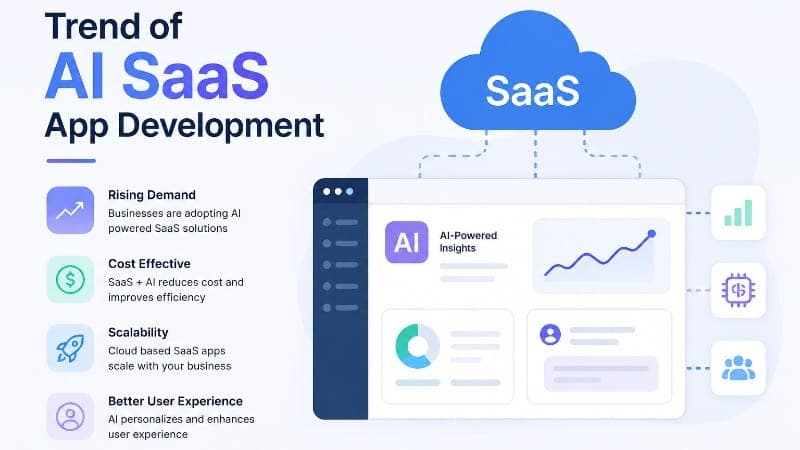
The current state is developing very quickly. No company finds it sufficient to have software which simply holds information for them. Nowadays, there is an increasing demand for software which understands human behavior, automates processes, analyzes, answers questions, and provides recommendations based on its analysis. These expectations of clients are one of the primary factors which made AI SaaS application development one of the most rapidly developing spheres of software industry.
As an example, take support services. Earlier, the client would raise a question in his ticket and wait for the reply of support specialist. Now, modern SaaS platforms can immediately answer to standard questions, help users with complicated actions and even detect any problems in advance. The role of AI here is not to replace human worker but to make his job easier, taking routine tasks away from him.
This transformation is visible across multiple industries. In healthcare, AI is being used for patient data management and diagnostics support. In finance, it strengthens fraud detection systems. Retailers use it to deliver personalized shopping experiences, while the education sector leverages it to build adaptive learning systems tailored to individual students.
In this article, we will explore why SaaS app development with AI is gaining so much momentum, the technologies driving this shift, and how businesses can prepare for the next generation of intelligent software.
Why SaaS is Shifting from Data Storage to Intelligent Decision Systems
Traditional SaaS platforms were mainly built to organize and manage information. They stored customer records, generated invoices, maintained documents, and helped teams handle routine business activities. While these functions are still essential, they are no longer enough on their own.
Modern AI-powered SaaS applications go far beyond basic data management. Instead of waiting for users to analyze reports, these systems can interpret data on their own and provide actionable insights. They can detect unusual patterns, forecast trends, recommend decisions, and even automate repetitive tasks without manual intervention.
For instance, think about a CRM that operates in a sales department. The regular CRM will keep all the information about the clients, track interactions, and store sales activities. On the contrary, the CRM based on artificial intelligence will be able to select promising leads, define the best timing for communicating with the clients, create personalized communication, and bring up clients who need immediate attention.
This opportunity to make decisions is one of the most important ones which make companies spend more money on AI solutions. The firm does not want just to have the database—it wants to get some improvements.
As cloud infrastructure becomes more advanced and AI integration becomes easier, organizations are increasingly shifting toward intelligent SaaS solutions instead of conventional applications.
Tip: Before adding AI to a SaaS application, it is important to clearly identify which business decisions can benefit from automation. AI delivers the most value when it solves real operational challenges rather than adding unnecessary complexity.
Automation Is Becoming the Core of Modern SaaS Applications
Another key driver behind the rapid growth of AI SaaS app development is the increasing need for automation. Modern businesses are actively looking for ways to reduce repetitive workloads so employees can focus on higher-value tasks such as strategy, creativity, and customer engagement.
Take an accounting system as an example. In traditional setups, employees manually handle invoice reviews, expense categorization, financial reporting, and error checking. With AI-powered SaaS solutions, many of these processes can now be automated. The system can extract data from documents, detect unusual transactions, organize financial records, and generate reports within minutes. While human oversight is still important, the overall workload is significantly reduced.
This shift is not limited to accounting. Similar automation is happening across customer support, human resources, marketing, logistics, and healthcare. AI is not replacing professionals but instead supporting them by removing repetitive administrative tasks and improving efficiency in daily operations.
One of the most important advantages of automation is its ability to scale over time. As businesses introduce new workflows, AI systems can adapt and improve without requiring a complete redesign of the software. This flexibility allows organizations to gradually expand automation based on evolving needs and feedback.
As more companies experience the benefits of intelligent automation, AI SaaS development is shifting from being a competitive advantage to becoming a standard expectation in modern software solutions.
Warning: Automating every process is not always ideal. Businesses should focus on automating repetitive tasks while ensuring that critical decisions and customer-facing interactions remain under human supervision.
Why Building an AI SaaS Product Is Not Enough
Development of a smart SaaS program represents merely one of many steps required for the creation of a successful product. After the completion of its development, companies still have to make sure that their customers will find out about, learn about, and trust their product. And this is exactly when marketing comes into play and becomes no less important than the program itself.
There are a lot of high-quality SaaS platforms which fail because they lack proper visibility strategy on the Internet. SEO, content marketing, and positioning help products distinguish themselves from the rest of the digital world.
It is also important to understand that marketing strategies differ depending on the target audience. A SaaS platform built for accountants requires a very different approach compared to one designed for entertainment-based industries. In some niche markets, businesses may even rely on specialized partners such as an SEO company for chaturbate models to reach their audience more effectively and compete within highly specific search ecosystems.
Ultimately, development marks only the beginning of the journey. The real success of an AI SaaS product depends on how effectively it reaches the right users and establishes its presence in the market.
AI Search Is Transforming SaaS Discovery

Building a strong SaaS application is no longer enough to guarantee success. Even if a product offers advanced features and solves real business challenges, users still need to be able to find it. In the past, businesses relied heavily on search engine optimization (SEO) to improve visibility on platforms like Google. While SEO is still important, the way people search for information is changing rapidly.
Today, many users prefer asking questions directly to AI assistants instead of typing short keywords into search engines. They expect detailed answers, comparisons, and recommendations in real time. Because of this shift, businesses are now thinking beyond traditional SEO and focusing more on how their brand appears in AI-generated responses.
This change has led to the rise of a new concept in digital marketing known as Generative Engine Optimization (GEO). Unlike traditional SEO, which focuses on ranking web pages, GEO focuses on improving how AI systems interpret, understand, and recommend content. As AI-driven search continues to grow, companies that adapt early are likely to gain a strong competitive advantage over those that rely only on conventional SEO strategies.
Another important development in this space is AI Search Monitoring. This practice allows businesses to track how their brand, products, and content appear across AI-powered search systems. Instead of only tracking keyword rankings or website traffic, companies can now see whether AI assistants are correctly mentioning their brand, recommending their services, or using accurate information when responding to user queries. These insights are becoming essential for refining digital strategies in an AI-first search environment.
The future of SaaS marketing will likely involve a combination of traditional SEO and AI-driven optimization strategies. Businesses that understand and adapt to this shift early will be better positioned as AI continues to reshape how users discover software and online services.
Tip: Businesses should not wait until AI search becomes their primary traffic source. It is important to start tracking how brands appear in AI-generated answers while continuing to strengthen traditional SEO efforts.
Choosing the Right Strategy for AI SaaS Development
As AI-powered SaaS app development continues to grow in popularity, one important factor remains consistent: success depends on strategy, not just technology. Simply adding AI features to a product does not guarantee value. Each business has different goals, users, and operational challenges, which means there is no universal blueprint for building an AI SaaS platform.
The first step in any development process is identifying where AI can create measurable value. Some businesses may benefit most from intelligent customer support systems, while others may need predictive analytics, workflow automation, recommendation engines, or natural language processing capabilities. Understanding these needs clearly helps development teams choose the right models, tools, and architecture.
Scalability is another critical factor that must be considered early in the process. As data volume increases and AI models become more advanced, the system must be capable of handling higher workloads without compromising speed or security. A well-designed foundation allows businesses to scale smoothly, add new features, and improve performance over time without needing to rebuild the entire system.
Companies that plan for long-term growth from the beginning are better positioned to adapt to future advancements in AI technology and evolving user expectations.
The Future of AI SaaS App Development Looks Smarter Than Ever
The growth of AI SaaS app development is not just another short-term technology trend. It represents a fundamental shift in how businesses expect software to function. Instead of acting as simple tools for storing and managing data, modern SaaS platforms are evolving into intelligent systems that assist users, automate workflows, analyze large datasets, and support faster and more accurate decision-making.
Looking ahead, artificial intelligence is expected to become deeply integrated into nearly every software system used in business environments. Applications will offer higher levels of personalization, understand natural language more effectively, automate increasingly complex processes, and seamlessly connect with other business tools and platforms. These advancements are already being applied across industries such as healthcare, finance, education, retail, logistics, and manufacturing.
Businesses that begin adopting AI today are not simply upgrading their software—they are preparing for long-term digital transformation. However, successful implementation will always depend on clear planning, defined business objectives, and a focus on solving real user problems rather than adopting AI for the sake of trends.
As more organizations transition toward intelligent systems, AI SaaS applications are expected to become the standard rather than an innovation. Companies that adopt early will likely gain stronger efficiency, improved customer experience, and a competitive advantage in an increasingly AI-driven market.
Conclusion
The development of SaaS App With AI represents one of the major tendencies in terms of the future of software solutions. The technologies that were once associated solely with cloud storage of information have evolved into highly intelligent tools that are able to learn, adapt and even contribute to the decision-making process.
In the future, SaaS products will become even more advanced thanks to the rapid development of AI technologies. However, being innovative will not be enough to succeed in this field. On the contrary, businesses need to concentrate on solving particular issues, developing efficient data systems, creating scalable architecture, and improving the user experience.
Meanwhile, visibility and digital presence will be another key factor. Regardless of how innovative and effective your SaaS app with AI is, if you lack good SEO, marketing, and ability to adjust to such trends as AI search or GEO strategy, it may fail to achieve the desired success.
To sum up, the future of SaaS is directly related to the development of intelligent and adaptable systems based on the use of artificial intelligence technologies.
📖 Read more blogs: Jorvea — Free Guest Blogging & Content Publishing Platform
Thomas - Digital Workflow
👋 Hi, I'm Thomas, a former Web Developer 💻 now specializing in SEO 🚀. I share practical SEO strategies 🔍, AI business trends 🤖, digital marketing insights 📈, and the latest tech updates 🌐 to help businesses and professionals stay ahead online.
Contributor at Jorvea — Free Guest Blogging & Content Publishing Platform
Frequently Asked Questions
Why is AI SaaS app development becoming so popular?
Businesses are increasingly looking for software that goes beyond simple data storage. AI-powered SaaS applications help automate repetitive tasks, analyze data more effectively, improve user experiences, and support faster decision-making.
Which industries benefit most from AI SaaS applications?
Industries such as healthcare, finance, education, retail, logistics, manufacturing, and professional services benefit greatly from AI SaaS solutions due to improved efficiency and automation capabilities.
Does every SaaS application need AI?
Not necessarily. AI should only be implemented when it solves a real business problem or enhances user experience. Unnecessary integration can increase complexity without meaningful benefits.
Why is SEO important for SaaS applications?
SEO helps SaaS products gain visibility in search engines, allowing them to reach potential customers. In addition, newer approaches like GEO improve visibility within AI-generated search results.
What is AI Search Monitoring?
AI Search Monitoring is the process of tracking how a brand, product, or website appears in AI-generated responses. It helps businesses understand how they are represented across AI-powered search systems and improve their content strategy accordingly.


%20(1)_1779803538805.png&w=1200&q=75)