AI Detectors Are Being Used Everywhere
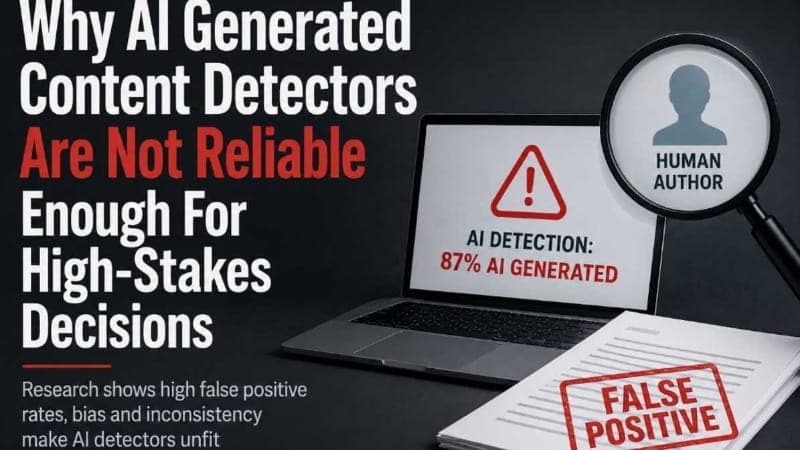
AI-generated content detectors are rapidly becoming part of modern decision-making systems. Universities use them to flag student assignments. Recruiters experiment with them during hiring processes. Publishers and SEO agencies use them to filter submissions. Some governments and legal institutions have even explored them for fraud and misinformation detection.
But there’s a growing problem: the technology is far less reliable than many organizations assume. Despite confident marketing claims from AI detection companies, researchers, educators, and technologists continue to find that AI detectors regularly produce false positives, false negatives, and inconsistent results.
In high-stakes environments — where a student’s academic future, a journalist’s credibility, or a professional’s reputation may be affected — those errors carry serious consequences. The central issue is simple: AI detectors do not actually “know” whether a human or AI wrote something. They make probabilistic guesses based on writing patterns.
What Are AI Content Detectors?
AI content detectors are software systems designed to estimate whether text was written by a human or generated by an AI model like GPT-4, Claude, Gemini, or other large language models. Most detectors rely on statistical signals such as: Predictability of word choiceSentence structure consistencyBurstiness and perplexityRepetition patternsLinguistic probability distributionsIn simple terms, detectors look for writing that appears “too statistically smooth” or machine-like.
Popular AI detection tools include:
- GPTZero
- Originality.ai
- Turnitin AI Detection
- Copyleaks
- Winston AISapling AI Detector
The problem is that human writing can also appear statistically predictable — especially academic, professional, or non-native English writing. That overlap creates major reliability issues.
The False Positive Problem Is Bigger Than Many Realize A false positive happens when a detector incorrectly labels human-written content as AI-generated. This is arguably the most dangerous failure mode because it can wrongly accuse innocent people of cheating or dishonesty. Several documented cases have shown this happening in schools and universities.
In 2023, multiple students publicly reported being accused of using ChatGPT despite writing their assignments themselves. Some cases involved students whose writing style was formal, concise, or grammatically polished — traits detectors often associate with AI. Research has reinforced those concerns.
A widely discussed Stanford University study found that AI detectors disproportionately flagged writing from non-native English speakers as AI-generated. Essays written by international students were much more likely to trigger detector systems because their language patterns tended to be more formulaic and grammatically consistent. That creates a potentially serious equity issue in education.
AI Detectors Often Contradict Each Other Another major reliability issue is inconsistency. The same piece of writing can receive dramatically different scores depending on which detector is used. A human-written article might be labeled: 92% human by one detector68% AI-generated by anotherCompletely AI-generated by a thirdThis inconsistency reveals an uncomfortable truth: there is no universally accepted scientific standard for detecting AI-generated text.
Unlike plagiarism detection — where copied text can be directly matched against known sources — AI detection is inferential. It relies on probabilities rather than evidence. That means results can vary widely depending on:
- The detector’s training data
- The scoring methodology
- Threshold sensitivity
- The specific AI model being tested
Modern AI Models Are Becoming Harder to Detect The reliability problem is accelerating because generative AI systems are improving rapidly. Early AI-generated text was easier to spot because it often sounded robotic, repetitive, or unnaturally formal. That is no longer true. Modern large language models can intentionally vary sentence structure, imitate human tone, introduce stylistic imperfections, and adapt to niche writing patterns.
Some AI models are even trained specifically to evade detectors. This creates what cybersecurity experts would call an “arms race”: AI models improveDetection systems adaptAI models improve againThe result is a constantly shifting target. A detector that performs reasonably well today may degrade significantly within months as new language models emerge. This instability makes long-term institutional reliance risky.
Even OpenAI Quietly Backed Away From AI Detection One of the strongest signals about detector limitations came from OpenAI itself. If even the creators of GPT systems could not build a highly reliable detector, that raises important questions about the broader industry’s claims. Many commercial detector vendors continue to advertise high accuracy percentages, but independent benchmarking often paints a much murkier picture.
High-Stakes Decisions Require High Confidence In many industries, imperfect technology can still be useful. Spam filters are imperfect, yet valuable. Fraud detection systems sometimes produce false alerts, yet still help banks reduce risk. But the acceptable error threshold changes dramatically when consequences become severe.
A university expelling a student for alleged AI use is not a low-stakes scenario. A publisher rejecting a journalist’s work based on detector scores is not trivial. A company making hiring or compliance decisions using unreliable AI attribution systems introduces both ethical and legal risk. High-stakes decisions require: TransparencyExplainabilityConsistent standardsAuditable evidenceDue processCurrent AI detectors struggle to provide all five.
Detection Scores Are Often Misunderstood One of the most common misconceptions is treating detector scores as factual proof. A score saying “87% likely AI-generated” sounds authoritative, but statistically it does not mean: There is an 87% chance AI wrote the textThe tool is 87% accurateThe content is definitively AI-generatedInstead, these systems typically estimate how closely writing resembles patterns observed in AI outputs. That distinction is critical. A highly structured human writer may trigger elevated AI scores.
The Bottom Line
AI-generated content detectors are not useless — but they are not reliable enough to independently support high-stakes decisions. The technology remains probabilistic, inconsistent, and vulnerable to both false positives and rapid model evolution. As generative AI becomes more human-like, the challenge of accurate detection may become even harder, not easier.
📖 Read more blogs: Jorvea — Free Guest Blogging & Content Publishing Platform
Frequently Asked Questions
What is AI Detectors Are Being Used Everywhere?
AI-generated content detectors are rapidly becoming part of modern decision-making systems. Universities use them to flag student assignments. Recruiters experiment with them during hiring processes. ...
Why is AI Detectors Are Being Used Everywhere important?
This article explains the key aspects of AI Detectors Are Being Used Everywhere in detail, covering essential information and practical insights.
How can I learn more about technology?
Read the full article on Jorvea for comprehensive information about AI Detectors Are Being Used Everywhere and related topics.