

Why Does Growing a Business Feel Harder Than Starting One
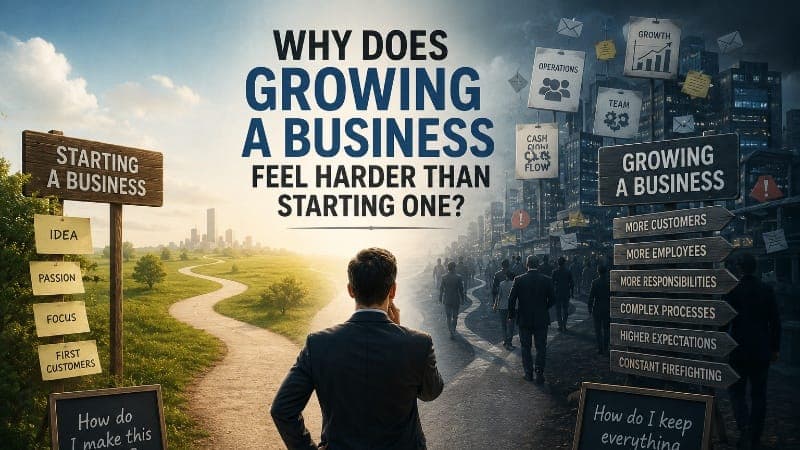
When you start a business the first question that comes to mind: How do I make this work?
Starting a business often feels surprisingly straightforward. All you need is an idea, hand ful of customers and determination to make it work. Almost any entrepreneur will probably tell you the same thing.
But as your business begins to grow, that question changes to " How do I keep everything running"
More customers, more employees, and more opportunities are all signs of success. However they bring new responsibilities, greater complexity, and challanges you never had to think about in the beginning and suddenly you are spending less time growing your business and more time managing people, processes, and day-to-day operations.
That is why starting business is difficult but growing one can be even more challenging.
What Does Business Growth Actually Mean?
Business growth doesn't happen overnight. It happens one customer, one project, and one new hire at a time.
In the beginning everything feels manageable because you are invlove in almost every decision. You know your customers personally, your team is small, and keeping track of daily operations doesn't require much effort.
But as the business grows, the way you work has to grow with it. Business expansion is not just about more number, it is about a change in business operations. It is usually become apparant to the founders when they no longer do all the things on their own. At this stange owners will probably experince a tootal tranformation in their work load. This is the point where entrepreneurs hit a wall.
Common Growth Range
It most often occurs in the first 1-3 years, when company expand from a single or two-person team to a small team. At this point many founders begin to doubt their systems, their employees, and themselfves with regard to their job in the business. However it may occur sooner than later depending on the growth rate of businesses.
Operational and Emotional Changes
This phase can be stressful and often manifests as an inability to fight fire or making decision fatigue.
These are some common problems found by the founders.
A sense of fire-fighting rather than planning: a constant feeling of putting fire out instead of planning ahead, and that the business is running the owner rather other way around.
Growth Dissatisfaction: Working long hours but the company is actually peforming the same level as before.
Frequent Comparison or doubt: Focusing on making frequent comparison to other businesses, or worrying about whether a business is growing at a rate that is quick enough.
Myths VS Reality
It is very common and incorrect for both to think that growing a business should be easier than starting a business. It's a myth that more money equals more stress and it varies, depending on the founders
Why Creating a Small Business is Easier?
Growth feels harder mainly because it multiplies the number of moving parts a founder has to manage at once.
Once a business survives its early stage, founders face a different kind of pressure.
Generally, they take on more staff, more customers, and more systems, almost as a visible sign that the business is working. But this also means more decisions, more communication, and more room for something to go wrong.
Here are the key reasons why growth feels harder than starting out.
- More People Involved in Every Decision One of the key reasons is simply that decisions no longer belong to one person.
- Founders have to pass information to employees, and employees have to pass it back. This slows things down that used to happen instantly.
- Old Systems Reaching Their Limit While a founder may have relied on a notebook or a spreadsheet early on. As the team and customer base grow, this same system starts causing missed jobs, delayed invoices, and confused staff.
- Why the Pressure Persists The reason this pressure doesn't go away on its own is that complexity keeps building with every new customer or employee, while the founder's available time stays the same.
Growth Across Different Business Stages
Every business experience growth differently according to its size.
Early-Stage Businesses (0 to 5 employees): Mostly rely on the founders personal involvement in almost everything, including sales, delivery and admin
Mid-Stage Businesses ( 5 to 20 employees): More people are leaning towards delegation and simplified systems, but there are many who are continuing to operate a tool that wasn't designed to handle a team this large.
Established Businesses ( 20 + employees): Understand the need for structure and generally invest in dedicated systems, defined processes and clear reporting.
Differnet Businesses Need Different Systems
Every business grows differently and so do its operational challanges.
A marketing agency may struggle with project management and clients approvals.
An e-commerce business often face challanges with inventory management and order fulfilment.
A consulting firm typically needs better documentation and collaboration.
A service business usually struggles with getting right technician to right job with right information. This is where field service management tool become useful for service business and with growth new adoptions are better.
However there is no single fix that works for every business, but every growing company benefits from less manual work.
What founders and Advisors Actually thinks About Growth
Starting a business has been connected with risk, hustle, and uncertainty for a long time. There is something about the early stage that makes founders feel like anything is possible. On the other hand, growth is not necessarily a smoother version of that same energy. It is treated as a separate, and often heavier, stage of business.
As one small business owner put it after crossing into a second decade of operation, starting the business only asked for courage, but growing it asked for patience, structure, and the willingness to stop doing everything personally.
Operational Prespective
Complexity Multiplies – Operationally, growth is seen as the point where a business's systems get tested against real demand. It is the stage where shortcuts either get fixed or start causing real damage.
Cash Flow Pressure – Another operational reality is that growth often strains cash flow before it improves it, since new hires and new equipment usually arrive before the revenue that justifies them.
Business Advisors' Opinion
Here are a few common opinions shared by people who work closely with growing businesses.
Systems Over Hustle – Advisors generally recommend building basic systems early, such as documented processes or shared scheduling tools. They view this as more sustainable than relying on the founder's memory and energy alone.
Delegation Over Control – Professionals observe that letting go of small decisions matters more than hiring more people. A business that delegates outcomes tends to move faster than one that only delegates tasks.
Assumptions:
Old Assumption – The idea that a founder should be involved in every decision possibly comes from the early stage, where that level of involvement was genuinely necessary.
New Reality – In a growing business, that same involvement becomes the bottleneck. The founder's job shifts from doing the work to building a business that can run without them doing all of it personally.
What Makes Growth So Draining
Here are the main reasons growth feels heavier than founders expect.
- More Moving Parts The main reason is simply volume. More customers and more staff mean more decisions happening at the same time.
- Delegation Discomfort Handing off tasks that used to be done personally creates a small but real loss of control, even when it's the right move.
- Cash Flow Timing Expenses tied to growth usually arrive before the revenue that justifies them, creating pressure that wasn't there in the early stage.
- Identity Shift The founder has to move from being a doer to being a manager, and eventually a leader, which is a slower and less comfortable transition than it sounds.
Managing Growth the Right Way
As growth tends to expose every shortcut a business took early on. It mostly stays manageable if founders build the right structure before they're forced to.
Here are the key steps for managing growth properly.
- Document What's in Your Head Genuine, repeatable processes are the gold standard for running a business without the founder personally holding everything together.
- Delegate Outcomes, Not Just Tasks It is far more reasonable to hand someone a result to own compared to only handing them a checklist to follow.
Best Areas to Focus On
The best areas to prioritize when managing growth are scheduling, communication, and cash flow tracking.
Documentation is widely used across growing teams to reduce repeated questions. Delegation is best for freeing up a founder's time for higher-level decisions. Cash flow tracking is a modern necessity, especially once payroll and supplier costs start rising together.
What Works at Each Stage
It is suitable for early-stage businesses to rely on simple, shared tools and clear written processes.
Mid-stage businesses mostly benefit from adopting dedicated systems such as scheduling software or a CRM that gives everyone the same information.
Established businesses, and beyond, mostly need clear reporting, defined roles, and systems that don't depend on any single person to function.
Practical Tips
Weekly Reviews – In a growing business, priorities can shift quickly. Reviewing cash flow and workload weekly instead of monthly helps catch problems early.
Clear Ownership – Pair every recurring task with one clearly responsible person instead of leaving it to whoever has time.
Right Tools – The most useful additions for a growing team are shared scheduling systems, simple CRMs, or accounting tools that reduce manual tracking.
Final Verdict
That concludes our breakdown. Remember, growth has no shortcut. It does not matter how well a business started, it will eventually be tested by its own success. Growth is a natural, demanding stage instead of a sign that something has gone wrong.
Managing it well is regarded as a matter of systems, not luck. In any growing business, structure is, of course, what turns a busier season into a stronger one.
📖 Read more blogs: Jorvea — Free Guest Blogging & Content Publishing Platform
Frequently Asked Questions
Why it is hard to grow a business?
Because complexity multiplies faster than revenue while other things stay same.
Is It normal to feel overwhelmed while a business is growing?
Yes, most founder hit this stage once old system can not keep up with new demands.
What's the biggest mistake growing businesses make?
Waiting until something breaks instead of building the system early.
what helps a business handle growth better?
It should be using scalable systems, strong planning, effective financial management and skilled teams


_1778751728189.webp&w=1200&q=75)